Tuesday, February 17, 2026

The “So What?” Has Changed With AI

Over twenty years ago, we launched an eighth-grade independent research project affectionately known as the IRP. The goal was to cultivate independence and self-direction within a defined time frame while honoring the power of student choice in self-guided learning. That choice fueled motivation and passion. What began as a project rooted in the American History curriculum evolved into IRP World, with a broader focus on global change.

The final component of the project—the “so what?”—had always been both the most important and the most challenging part of the process. We pushed students to move beyond reporting events and instead examine impact. How did this event influence societal, financial, political, or cultural change in that region of the world? The project was not about summarizing information; it was anchored in analysis.

In 2026, this emphasis on the “so what?” is even more critical. Reporting facts is no longer the hardest task. AI tools can summarize events, compile research, and generate explanations in seconds. What distinguishes student thinking now is not what happened, but why it matters.

The “so what?” has become the clearest evidence of human reasoning. Students must move beyond information that AI can easily produce and demonstrate judgment, perspective, and synthesis. They must ask:

  • Why does this impact matter now?

  • Who benefits, who is harmed, and why?

  • What patterns, tensions, or implications are not immediately obvious?

In this context, the project is intentionally not about content reproduction. Instead, it centers on interpretation, ethical reasoning, contextual understanding, and original insight. A strong thesis reflects discernment, not just information.

Ownership in 2026 also means deciding what cannot be outsourced to AI. The “so what?” is where students demonstrate that they are not simply informed, but thoughtful, critical, and capable of making meaning in a complex world.

Source: ASIDE, 2026


Friday, January 14, 2022

What Is Wordle? 5 Ways To Use The Latest Puzzle Craze In The Classroom

Source: Wordle

If you haven’t yet heard about – or played – Wordle, you will soon. The current avalanche of Twitter mentions run about 50 / 50 between “I'm addicted to Wordle!!” and “What the heck is Wordle??” Our friend Dr. Gina Sipley (@GSipley) tipped us off to the craze via a writer's poignant plea in McSweeney’s for a moment's escape from the Omicron nightmare.

At its heart, Wordle is just a guessing game. Players have six chances to guess a randomly generated, five-letter word. After each entry, the tiles light up to signify whether the letter is not in the word (gray), in the word but in the wrong location (yellow), or in the correct location (green). The rules reappear at the start of each game. CNET, of course, has a terrific, lengthier explanation, complete with smart tips and tricks.

Source: Powerlanguage.co.uk

For teachers, this web-based game hits all of the technological sweet spots: 1) it's free; 2) with no logins or accounts; and 3) works on any device. And its addictive gaming properties turn out to be the exact same characteristics that make Wordle ideal for use in education:

Source: Wordle
Language And Linguistics

Wordle is the perfect opening activity to a Language Arts lesson, at almost any level. It also offers countless opportunities to explore the building blocks of the English language – such as vowel and consonant combinations (phonemes, diphthongs, etc.); common starting and ending pairings; and familiar vs. rare individual letters. The shear number of five-letter words in the English language (over 150,000) presents the challenge. Solving the riddle, however, is simple phonemic detective work.

Logic

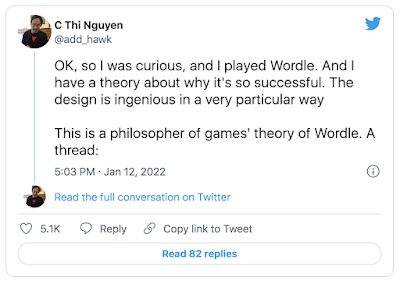
Any mathematics or logic course could make great hay out of Wordle’s elegant solving patterns. The reasoning relates clearly to geometric proofs and properties. An entire period could be spent leading the class through a group-solve. It echoes those LSAT puzzles when Priya is holding a red balloon and Xavier can only sit next to the dog in the yellow vest. Philosophy professor C. Thi Nguyen has an interesting thread about Wordle’s game theory and “agency expansion.”


Homeroom Or Advisory

Wordle is a lively activity to engage students in a quick challenge. The unique thrill is that only one puzzle appears each day. This creates an increased anticipation and savoring of the moment. You can welcome students to work in groups or to compete in speed vs. accuracy. Be a sport and play the game yourself, to show that you’re not afraid of some friendly fun.

Source: Wordle


Visual Thinking

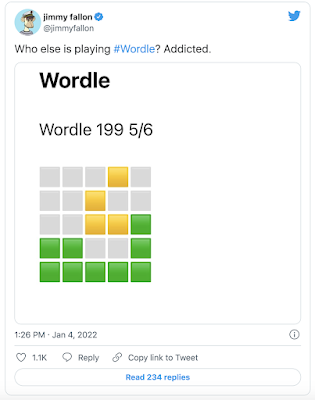
The clean, elegant interface belies the effectiveness of its iconography. The simple visual codes contain the game’s entire meaning and feedback. The sharable results, rendered only in colored cubes, represent masterful lessons in visual literacy and graphicacy.

Social Learning

Everyone plays the same puzzle each day, which lends a contagious camaraderie to the effort. Results are easy to share on social media. This does lead to some humble brags and “woe-is-me,” but it's refreshing to find some fun and support during these oft-disconnected times. You might even run into a celebrity or two.


As an aside, we are old enough to remember when a “Wordle” referred to a visual cloud representing the frequency of word usage in a passage.

Finally, don’t tell, but there is an open-source version on GitHub where you can play the game as many times as you’d like.

Saturday, December 18, 2021

This Says It All - How Do We Heal!

The end of another year gives us pause for reflection. The top search reported by Google Trends for 2021 was "how do we heal." We did not think much about it until we watched it and remembered just how difficult this year has been. Clearly, we have all been through so much. Our students were quiet, and our colleagues cried. Nothing else to add; it just helped us put things in perspective.

Saturday, December 4, 2021

I Con, I Saw, I Conquered - Digital Fluency

Source: ASIDE 2021


One thing we quickly learned during remote and hybrid learning involved the lack of understanding of screen iconology. We realized that our students needed to navigate the changing landscape of communication, not only for this unusual situation in pandemic learning, but also to understand the language of symbols on any digital device. It was one of those moments when adjustments to our instruction required a closer look at ensuring digital literacy to read and process crucial technology skills.

Source: ASIDE 2021
The pandemic emphasized just how much we took for granted our students' visual literacy of the icons that appear regularly in front of them. As with so much of visual literacy and thinking, graphicacy is the underpinning skill that our students require, and the need to educate learners beyond the written text in the illustrative and technological arts is essential.

The adjustments we made in the curriculum to build in skills for students to develop a range of pictorial proficiencies for decoding icons and their functionality paid off, particularly with our remote learners.

Visual fluency requires training and practice much the same as it does for reading; visual comprehension does as well. Today, students need to master multiple fluencies just as they do multiple literacies. Both require nurture and development to acquire these skills. We turned the learning process into a spy game for students to decipher the coded message using the icons. We provided a mentor text for them to grasp the idea and a one-page list of 32 icons to create their messages. Click here for a PDF version.

Source: Student Work

To save time, we set up a folder with small icons that we downloaded from the Noun Project in Google Drive that we shared with the students so that they could write their own coded messages. Click here for access to our icon folder. The students loved it.

This not only reinforced their learning of the icons, but it also allowed us to build in a variety of technology skills for retrieving the resources they needed from a shared folder, importing images into a Google Doc, and adjusting image size and text for readability. The students had a ball sharing their coded messages with each other, and we had the results we were looking for in developing the their digital device iconology.

Monday, November 29, 2021

Student Infographics Come A Long Way!

Source: 6th Grade Students

It's been over ten years since we first started using infographics with our students to make learning visible. They have certainly come a long way! Not only is this due to our ability to redesign aspects of our lessons to promote visual thinking and design, but also because the design tools are so much better. Our go-to creative tool now is Canva. It allows for so many options and templates. This flexibility enables students to make selections and modify their designs to look professional.

Since we use Canva it at multiple grade levels, they continue to perfect their visual literacy skills. The early "linear to visual" infographics using iPads and PicCollage seem so primitive now compared to the variety of selections in Canva. We do still use PicCollage for our Kindergarten through second grade students; it's a perfect tool for introducing our younger students to the art of learning and designing infographics.

Source: 6th Grade Students


Tuesday, December 29, 2020

Ubiquitous Google, The Blob Opera, And Student Creativity


Source: Google Arts & Culture

Our students fell in love with our refrain that "Google is ubiquitous; it's everywhere" when they realized that whatever they typed in their Google Docs showed up on any device. Now with Google Classroom, they especially see the connection that everything they need is synced in one place by multiple teachers. For educators, it makes hybrid learning streamlined for both remote learners as well as for those in the classroom, particularly when this situation remains fluid. Many know that the students are always checking their emails and Classroom with little to do because of the current situation.

Source: ASIDE Google Blob Opera

So when we recently sent out Google's new project called the "Blob Opera" to Classroom over the winter break, the students happily started making their own four-person, musical creations. Blob participation depends on the producer. It's simple and easy to launch. Compose an opera with blob vocals ranging from bass to soprano in just minutes. It's also easy to share via Google Classroom as a teacher, and students can send their creations in the same way as an announcement to their peers.

For more information, check out Fast Company's article on how to manipulate the blobs to create a symphony of your own chamber music. Google did not use any recordings of actual singers. Instead, it built the system by recording "hours of classic opera singers, and used that data to train an AI model to know and mimic what an opera singer should sound like."


It's a nice way to end a crazy year by bringing in a new one with a little joy and creativity. If you're not actively checking Google's Art and Culture resources, start today.

Here's an opera from a very proud student: Irene's Blob Opera

Monday, December 7, 2020

'Tis The Season And Joy Was On The Menu - Student Designs To Promote Well-Being

Source: 6th Grade Students

It's December, and it's been a long, long year for us as well as our learners. We're teaching hybrid, and our students go in and out depending on concern and fear of the virus. They definitely needed a pick me up by week 13, and that's when we read Dr. Dolly Chugh's recent post on Dear Good People entitled, "No Justice, No Joy." 

Source: Dear Good People


We couldn't ask for a more perfect advisory activity to promote joy as well as student agency and creativity. The students received a quick overview of the seven tips for a "Quick Joy Sandwich," with instructions for designing their own "Joy Menu" using a Canva template.
 
Source: 6th Grader
 
Their charge was to think about the heading from the article that read "Joy is as essential as food" to create a menu complete with appetizer, main course, and dessert. They loved it. Each student brought his or her own take to the three course meal, and each handled the descriptions differently. They took the opportunity to create catchy headings of their own with descriptions for their plates that were anything but food. 
Source: 6th Grader

We wish we could share all of them, but the sampling is indicative of what can happen when kids have free range to express their joy, especially in the world they live in right now. For a full size look at these joyous delights, click here. No matter the season, joy is as essential to learning as it is to the social and emotional well-being of our learners.


What would your joy menu look like? As Dolly Chugh recommends, take a look at the tips she provides and make your own "Quick Joy Sandwich."


Source: 6th Graders


Related Posts Plugin for WordPress, Blogger...


Pin It