Friday, January 6, 2012

The Innovators At Our Doorstep (More Than Tagalongs)

Outside of the classroom, respected communities can help animate young minds with activities tailored to loyal learners. One noble outfit, the Girl Scouts of the USA, is continuing its century-long mission of inspiring women and girls while at the same time shedding any vestige of musty orthodoxy. Recently, the Girl Scouts redesigned the requirements of their seminal programs. They reimagined their badges, too, to present an invigorated model of forward-thinking leadership for a new generation.
Girl Scout Innovation Badges
Source: Fast Company Co.Design
The goal of repositioning the badges, properly called insignia, was to commemorate the 100th anniversary of the Girl Scouts by looking ahead to the next 100 years. The aim was to establish a balanced table between boys and girls, to emphasize leadership among young women who might otherwise opt out of captaining roles. The Girl Scouts retained their time-honored legacy badges, but they also added new modules for “Millenial ideals.”

The most intriguing of the new insignia are the innovation badges. Fast Company’s Co.Design blog recently featured a terrific write-up, by Lauren Pollak of strategy consulting firm Jump Associates, entitled “What Designing The New Girl Scouts Innovation Badges Taught Us About Raising Leaders.” Pollak smartly positions the logos' designs within the overall context of empathy and learning. We strongly encourage you to read the entire piece, which is fascinating in its support of empowering education for young women.

Source: Original Champions of Design
The levels of badges range from inventor to social innovator. The courses seek to “leverage children’s existing creativity,” “train hybrid thinkers,” “build empathy before solutions,” and “enable great storytellers.” With such a progressive culture and vibrant vision, it’s clear the girls are leaving their reactionary scouting cousins in the dust.

Digital Movie Maker Badge
Source: Daily Mail Online
As part of an overall rebranding effort led by Original Champions of Design (OCD), many programs have either been initiated or tweaked to revamp the Girl Scouts' daily practice. Contemporary courses in financial literacy, for example, have been added as companions to the annual cookie sales. Badges for Making Choices, Money Matters, and Philanthropist all foster life-long habits of investing. Other conventional subjects have been updated to reflect advanced studies, such as the Science of Style, Science of Happiness, Digital Movie Maker, and Eating for Beauty. Additional of-the-moment insignia include Locavore and Netiquette, which progress satisfyingly from earlier, “innovative” badges in Canning and Telegraph. There are even "journey" awards, called "It's Your World - Change It!"

Source: Main Street; The Girl Scouts
The Girl Scouts have always been entrepreneurial in peddling their luxuriously-priced Samoas and refrigerator-ready Thin Mints. Now, the self-reliant spirit is being taught from an early age. In all, the new designs reflect the importance of educators keeping current and staying relevant in children's eyes. In this respect, teachers can learn from the Girl Scouts’ impressive equilibrium in remaining faithful to tradition and in rethinking what it means to be “excellent.”

We apologize, by the way, if we have misused any nomenclature for the various levels of scouting. Also, we also recommend this clip of CEO Anna Maria Chávez explaining how the Girl Scouts are modernizing. One thing is for certain: the Boy Scouts are now officially behind the times.

Monday, January 2, 2012

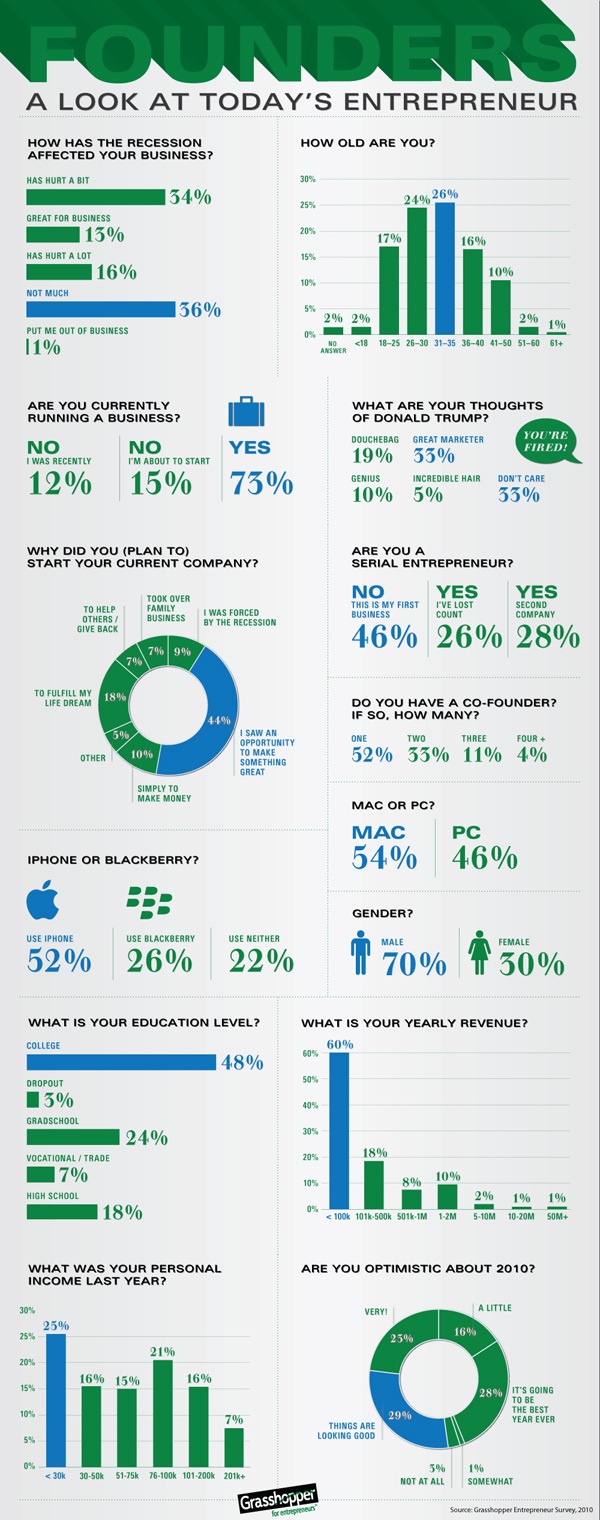
Picture This, Picture You: Infographics for the Entrepreneur

Source: FastCompany
This year, we incorporated a new, interdisciplinary project-based learning unit into the fifth-grade curriculum called “Entrepreneurship: Where Ideas Meet Money and Marketing.” The essential question for the students was, “What is an entrepreneur, and how does an entrepreneur build a business out of an idea to change the way people think?” The challenge for them was to come up with a business plan to market a good or service as an entrepreneur to the school community.

Source: Grasshopper Group


We used infographics to help them visualize the traits of an entrepreneur, who they are, and the types of challenges they face in creating their own businesses. Graphics helped the students clearly see information that is usually not geared for the average ten-year-old. The level of complexity was also a way to differentiate the information depending on the learner. They could self-select areas to focus on in the image at various levels of comprehension that would match their abilities.

Source: TechLifeMashup
The benefits of the project were multifold for student learning and supported by many articles in education dealing with entrepreneurship, innovation, and creativity. According to the government’s Small Business Administration, entrepreneurs under age 30 start approximately one third of new businesses annually, and small companies account for 99.7 percent of employer-owned firms that create over 64 percent of new jobs. The added plus of using infographics to learn about entrepreneurship helped make the project a huge success.

For a closer look at these infographics click the links below:


Friday, December 30, 2011

2011 - The Year of #PencilChat

What started out as a small exchange on Twitter between middle school teacher and author John T Spencer (@edrethink) and technology consultant David Wees (@davidwees), using the hashtag #pencilchat in early December, turned into a viral banter with over 10,000 tweets that is still going strong. It all began with Spencer's book, Pencil Me In: A Journey in the Fight for Graphite, about using pencils as an allegory for educational technology. Some of the reasons the author believes #pencilchat went viral include: there was enough diversity of people spread across the web with friends to make it work; it moved geographically from the United States to Australia and around the globe, never stopping; it was a fun, quirky and creative mix about pencils from attitude to metaphor; and most of all, it was easy and approachable.

It was too much fun to resist and also oh-so-telling about the frustration of technology integration. GOOD magazine picked it up with a post called Why #Pencilchat May Be the Most Clever Education Allegory Ever, with some great tweets including, "Jesus was a good teacher and he didn't use a pencil, so I don't have to use one, either." Aside from some of our favorites listed below, we came across this animated video, Ode to #Pencilchat: Technology Integration in the Classroom, from the Think and Dream in English blog. It was put together to use at professional development workshops about technology integration in the classroom.


Some of our favorite #pencilchat tweets, including some of our own:
"A pencil is only as sharp as the person using it. On the other hand a good pencil makes a person sharper." @e_skymac

"I refuse to use pencils in my classroom until manufacturers figure out a way to limit what students can write with them." @erinneo

"We must remember our 'pencil immigrants' were not born 'pencil natives.'" @theASIDEblog


"
My district has upgraded my pencils but the new pencils won't work with the old sharpener and there is no money for a new one." @clcolbert  


"The problem with pencils is that kids are going to use them to copy stuff out of books." @ericnentrup|


"Effective pencil-integration isn't about the pencil, it's about what you do with the pencil." @clsmithdpu

"We're pretty slow with the hunt-and-peck writing method. Any spelling errors are just mis-writes: 'pencil-o's. Not our fault." @theASIDEblog

"If the global supply chain ever confronted a shortage of No. 2 pencils, the American education system might collapse." @itsmelaurabeth

"When I buy pencils for classroom student use, it becomes an equity issue in the building." @gilkatgil

Wednesday, December 28, 2011

Graphicacy: 4 Steps To Understanding An Image

It’s easy to recommend that students learn how to decipher an image. It’s harder to explain the specific steps of instruction that can help children comprehend the pictures they encounter.

P.D. Wilmot (1999) cites Dale’s and Seel’s (1994) earlier works in outlining methods of graphic communication. They point toward understanding literal meaning, inferring between the lines, and applying ideas in one’s own voice.

In our classes, we've used similar practices. Our approaches toward elementary and middle school learners have tried to be clear and systematic. Here are two formats that we’ve used successfully for several years in analyzing political cartoons and in questioning media advertisements.


Typically, we move through four steps in guiding students to interpret charts, maps, cartoons, infographics, and logos. These four steps progress from base-level identification toward more analytical and sophisticated skills. The understandings proceed from: 1) Substance, 2) Scaffold, 3) Story, and 4) So What?

By “Substance,” we mean the literal things that appear in an image. Regardless of meaning or significance, what actual items do we see? Is that a bear and a honey pot, a continent and an ocean, or a curved line and an arrow? Are there words or numbers in the picture? By listing all of the details, we can be sure that we’ve noticed all the necessary pieces before beginning to determine what they might mean.

Scaffold” refers to how the image is constructed. What structures define the picture as a graph, or a map, or a painting? What are the relationships between the details? For example, is there a grid, or an x/y axis, or a table of rows and columns? Are there cartoon people of different sizes between a title and a caption? Are there percentages connected by flow-chart arrows? Are there lines of latitude and longitude? Are there keys or legends explaining the color-coding? Are there markings or symbols or abbreviations? By defining the type of image and its construction, we can identify how the details unite to create a meaning.

Story” is the message or the meaning of an image. In other words, what is a picture trying to tell us? What is the opinion of the cartoonist or the narrative of the illustration? What is the take-away from the pie graph or the point of the cause-and-effect comparison? The “story” is the purpose of the military map or the corporate logo. It is the overall meaning of the graphic.

Finally, “So What?” emphasizes an image’s importance. Who cares? Why is the graphic valuable? What deeper significance can we construe? How can we put the image in its proper historical, financial, or media context? How can we glean ideas to apply in our own lives or in other situations? Why would we waste time examining this particular image? What are the larger, interesting conclusions to infer from this unique picture?

Saturday, December 24, 2011

Matchbox Kids, Not Toys - End Slavery

Source: BBC
In response to reading a blog post from Cool Cat Teacher Blog to raise awareness about modern day slavery during this holiday season, one thing came to mind, candles. It is not just the significance of candles for the Christian holiday of Christmas, the Jewish holiday of Chanakah, or the African celebration of Kwanza, but also matches. Candles are lit for each of these festivals to mark a special occasion. When we light candles, we often use matches, but how often do we think about where matches come from other than the store? Do most people know that India is one of the largest producers of matches, or that a vast majority of its match making industry is supported by child labor? Well, it is.

Here are just a few simple facts from the website Products of Slavery:
  • In one of India's matchbox factories, ten-year-old Kavitha was made to grind a highly combustible mixture, leaving her with permanently blackened hands. Source : UNICEF, 2005, "India: Project Helps Child
  • A study carried out in India found that children working in matchbox factories earned the equivalent of just two euros a week for 12 straight hours of work. Source : International Confederation of Free Trade Unions, 2006, "India: Economic Boom Masks
  • In 2002, as many as 66,000 children, aged between six and 14, were found working in matchbox factories in the Indian city of Silvasi alone. Source : International Confederation of Free Trade Unions, "India: Economic Boom Masks Widespread Child Labour," October 2006, Pg. 2
Source: Child Labor in India
India has a huge child labor problem, and many children as young as six years old work long hours each day for miniscule pay. Many are employed in match factories, as well as in the fireworks industry. Injuries abound, and they are too poor to get treatment for their ailments. Many, too, keep working because they are so poor. According to Legal India, of the 200,000 workers in the labor force in the matchbox industry, experts claim that 35% are children below the age of 14. They are made to work over twelve hours a day, beginning work at around 4:00 a.m., everyday. For an incredible documentary on the subject, watch the video Child Labor in India. It is not for the faint of heart.

So this holiday season as you light candles in celebration, perhaps think about ways to help educate our students to make the world a better place for exploited children and to put an end to slave labor.

Wednesday, December 21, 2011

Is 2012 the Year for an Educational R/Evolution?

Source: Time
The announcement of Time magazine’s 2011 “Person of the Year” as “The Protester” reminds us of the 2006 issue that declared “You” as its selection for the individual contributions made by user-generated information. Since 2006 a lot has changed in the world of technology and information sharing. The floodgates have opened and anyone, anytime, anywhere can share their ideas. There is no turning back. The amount of content generated for the World Wide Web by individuals now far exceeds the amount produced by experts.

Source: Time
The advances in technology allow for form to be separated from content. In other words, content no longer depends on finite structures within the restrictions of code to create material on the Internet. Instead, individuals create, share, and publish content with incredible ease, allowing us to be the designers and distributors of our own content. In Michael Wesch’s video produced in 2007, Web 2.0…The Machine is Us/ing Us, a line types across the screen that reads, “The Web is linking people…Web 2.0 is linking people…people sharing, trading and collaborating.” For Wesch, media changed the way people interact with each other, and as a result, human relationships changed, too.

This year, the frustration felt by millions nationally and internationally reached breaking points. The Tunisian fruit vendor who set himself on fire had no idea that this would be the beginning of the “Arab Spring,” toppling dictators in major countries in Africa. The protestors who set out to show their frustration and anger in the Occupy Wall Street movement hit a raw nerve in the American public, stemming protests around the country that grew in size and number. So how does this relate to education? Well, for one thing, we are heading into 2012, six years past the recognition of “You” by Time magazine, yet schools still try to block and restrict not only technologies, but teachers as well.

Source: Certification Map
To top it off, we have a growing number of disgruntled youth in America who drop out of an education system that sees them as a number but fails to see the ensuing impact on society as a whole. In hindsight, our growing dropout rate as a nation should have been predictable. Conformity and measurement are used to define students, yet we constantly talk about differentiation, multiple learning styles, and the whole child. The words "motivate" and "engage" appear in countless educational books, articles and conference sessions. At the same time, the daily press reports on holding teachers responsible for poor standardized test results. It seems ironic: on routine assessments in academic classes throughout the year, the student is accountable for his or her success or failure, but not on standardized testing, where a student’s poor performance is blamed on the teacher without regard to class work. This leads us to ask the question, how many teachers will “dropout” from conformity and measurement?
Source: Network movie clip on YouTube
Just think how much more we could engage students if we were not so close to the edge of a cliff. Teachers want change. Just follow the streams of passionate teachers on social networking websites such as Twitter and Facebook. Their frustration can be felt, including the pressure from virtual, for-profit, and charter schools as the panaceas for educational ills. Is there a bright spot at the end of the tunnel?

Well, there are breaks in the ranks. States seek waivers to opt out of NCLB requirements, Long Island principals protest new New York State teacher evaluation based on test scores, and students nullify a standardized test in defiance by writing essays about squirrels. Perhaps it's time for educational leaders, teachers and students to be like the memorable character Howard Beale in the 1976 movie Network and start shouting, "I'M MAD AS HELL AND AND I'M NOT GOING TO TAKE IT ANYMORE."

Technology has altered the learning landscape, and the educational system is reluctant to change with it. The youth of today do not live in a static world. For them, at least outside the classroom, the world is dynamic, interactive, animated, and collaborative. In fact, they know how to collaborate better than the hierarchical systems imposed upon them. Information in their world is fluid. In other words, content is free from the constraints of structural limitations. Students recognize this. Outside the classroom they are free from the restrictions of blocked websites, filters, wired access, and standardized tests. They know there are multiple points of view and access them with ease.
Source: Michael Wesch, Information R/evolution
To them there is “no shelf system” for categorizing or telling them what they need. They generate content at lightning speed, they publish continually on the web, and they design how, when, and what they want to learn, follow or ignore. As educators, we can learn a lot from our students and would do best to stand up for designing content that is pertinent, rich, and connected.

Source: United Opt Out National
Something needed to give, and now it is.  United Opt Out National is a group of parents, educators, students and social activists who are determined to bring about change to end standardized testing that they see as destructive to ALL parties. In addition to protests by New York State principals, the organization Save Our Schools wants to put the public back in public schools and supports the Call for Action that United Opt Out National has declared on January 7, 2012. Let's also not forget the guest post that went viral from the Washington Post's The Answer Sheet about the school board member who took a standardized test and did not fare so well. Perhaps with the new year upon us, the groundswells of revolution will bring about education evolution after all.

Sunday, December 18, 2011

Rick Santorum - Designing A Candidacy

During logo deliberations, a fledgling campaign must weigh its desired message against its candidate’s name recognition. “Newt,” for example, can get away with a single first name, like “Hillary” or “Ike,” because of strong voter identification with the individual’s brand. Herman Cain, Tim Pawlenty, and Thaddeus McCotter, however, were forced to lay a “get-to-know-me” groundwork in order to introduce themselves as presidential aspirants. In their cases, the messaging proved unsuccessful.

Source: Rick Santorum for President

Rick Santorum falls into this unfamiliar camp. Even with his two terms as an outspokenly conservative senator, he is little known to non-Pennsylvanians who weren’t watching Meet The Press in 2005. Santorum did build a name within the Republican caucus thanks to his fervent family focus. He rose to the position of conference chairman as the party’s megaphone for traditional values. In 2006, however, Santorum lost reelection to Bob Casey, Jr., by 18 points, the largest margin of victory ever by a Democratic nominee in Pennsylvania history. Santorum then worked as a low-key lawyer, columnist, think-tanker, and Fox News personality before announcing his run for president on June 6, 2011.

Given Santorum’s consistent policy positions but soft name recognition, we would expect his campaign logo to proclaim loudly his family principles. Instead, Santorum’s banner is a jumble of hits and misses. The all-caps lettering is clear but unremarkable in its insubstantial, barely modified Garamond font. The dueling red and blue colors of the first and last names fight against each other, pulling focus rather than offering a unified theme. The red hue, in addition, is a curious epicene tone between crimson and rose, officially known as “folly” (we’re not making that up).

The best part of Santorum’s insignia is the circle of stars and soaring eagle in the "O" of his last name. The bird is ascendant, evoking patriotic notes. Still, Santorum’s name is not common enough to be divided by a symbol. It almost appears as though his name is “Rick Sant Rum.”

Liberal activists have made Santorum a punching bag over his controversial statements. But his articulation of neo-conservative principles has won him praise during recent debate performances. Santorum's dedicated stops in each of Iowa’s 99 counties have also earned kudos for retail politicking. His slogan, therefore, should be a point of pride for the Santorum brand. Something akin to “Faith, Family, and Freedom,” which is the title of his current tour, would have established a resonant motto to reinforce his moral policies. Instead, the Santorum campaign chose “The Courage to Fight for America.” Bland and unexceptional, this formula could apply to any leader in any contest. It fails to connect to Santorum’s competitive advantage among faith-based, right-leaning voters. Even with his strong debate skills, we fear Santorum may never ride the polling surge his fellow second-tier candidates have fleetingly enjoyed.

Check out our other posts about design and education in the 2012 election.
Related Posts Plugin for WordPress, Blogger...


Pin It