Sunday, November 29, 2015

Social Media Is An Opportunity - Not A Problem In The Classroom

Source: ASIDE 2015

The resolute attitude of many schools to resist the “Social Age” by blocking websites within their walls strikes at the core of what it means to collectively share ideas. The system seems stuck in the notion that kids will do bad things if they have access to social media. Hello! They have access to it anyway, just not in school. We shake our heads every time we hear educators who want to share digital projects but can’t because of a school’s firewall. Some educators depend on the very students they teach to share when the leave the building in order to promote their work.

Source: ASIDE 2015
We value the opportunities at our disposal for creating digital portfolios with our students, running Tumblr pages for the humanities, maps, and classwork, using Twitter (@BCDS_History_56, @BCDS_History_78>)and Kidblog, and sharing through Padlet to engage in the open practice of real-life skills.

Social media is not the culprit. In this day and age, digital environments are not separate from physical environments. If we want our students to understand the importance of building a healthy, digital footprint for prospective college applications and employment, then practice is imperative. It can’t be taught from a book.

Source: ASIDE 2015
Like other educators, we see the value in using social media. We are fortunate to work in a school that believes students learn by actively and responsibly participating in an online community of practice. We firmly believe that learning communities that allow students to use social media in their education build stronger digital citizens. They also encourage parents to be more proactive in the online behavior of their children by participating as digital partners.

We made a passionate plea to educators in our presentation, entitled “Tear Down This Firewall: Using Social Media To Engage Students And Parents,” at the annual NYSCATE conference. We showed multiple ways that we have incorporated social media in the elementary and middle school classrooms, as well as demonstrated how the skills learned from social media include context, framing, information, perspective, questioning, and problem-solving. We hope the solid foundation in instruction behind our students’ work will provide motivation for others to approach their administrations to unblock valuable web resources for learning. We included our SlideShare presentation here.


Tear Down This Firewall: Using Social Media To Engage Students & Parents from The American Society For Innovation Design In Education

The value of modeling, practicing, and incorporating social media into the curricula to better educate learners for a world that exists now is vital to their development. It builds the collectiveness of the community and a trusted bond between all participants, including administrators, faculty, students, and parents. Most importantly, it takes the fear out of the equation.

 In 2010, Rachel Botsam coined the term “collaborative consumption” in her critically acclaimed book, What’s Mine is Yours: How Collaborative Consumption is Changing the Way We Live. The theory of “collaborative consumption” is the reinvention of traditional market behaviors that are taking place at a rate not seen before as a result of technology. These changes affect more than just the economy; they influence and disrupt traditional learning environments as well. It shouldn’t be a “Them vs. Us” mentality; instead, it should build a collaborative network of making, sharing, and responding.

Source: ASIDE 2015
Yet despite this social revolution in an on-demand, real-time world, schools are still resistant to change, even though educators try desperately to show the value of collaborative work by using social networking.

As for the students, the firewalls may not be crumbling yet inside the bricks and mortar, but outside, learning takes on a life of its own, unfiltered without restrictions. They hunt and gather wherever they can, and technology has opened that door.

Students need to construct their social capital through shared networks, and schools need to participate in building it, not restricting it.

For other resources please see:

Monday, November 23, 2015

Student Video Projects In Vine: The Six-Second Constraint Encourages Creativity


Source: Vine
Poets have long considered the sonnet and the quatrain as the highest forms of poetry. The strict meters, the rigid rhyme schemes, and the unbreakable line limits force poets to create elegant verse within exacting structures. In other words, if writers can craft soaring language under such restrictive rules, then they have true talent.

Making Vine videos with students falls into a similar category. Vine is a social network owned by Twitter that allows users to record or upload clips no more than 6.5 seconds in length. With over 200 million users and 1.5 billion daily loops, Vine has created overnight celebrities and has changed the way kids watch, generate, and share content.


The ease of publishing makes Vine a terrific tool for the classroom. The strict time limit of the videos forces students to maximize the pithiness of their messages. In other words, the short videos demand:
  1. Efficiency of narration
  2. Effectiveness of visuals
  3. Concision of message
Students cannot be wasteful in language or vague in communication. They must get their points across succinctly and above all creatively. They are compelled to invent novel ways to pack a lot of meaning into a tight space.


For example, our eighth-graders have been studying how technology and inventions transformed society in the late 1800s. We, therefore, invited them to conduct a mini-research project about modern inventions in the contemporary era that have similarly revolutionized daily life. Our instructions, storyboards, and rubrics are included in this post. We have also included several examples of the innovative approaches that students took to produce these brief films. For other ideas about incorporating Vine in the classroom, check out 20 Ways To Use Twitter's Vine In Education.

As with all social media, there is plenty of content on Vine that would not be appropriate for all ages. That is why digital citizenship needs to be a crucial partner with digital publishing. As with all online activities, educators need to encourage students to be their own filters, to use their own good judgment in engaging with social media.

Sunday, November 22, 2015

How To Comment In Social Media - An Infographic Of Tips For High Quality Feedback


Students are writing more than ever before. They are tapping out rapid-fire fingerstrokes across multiple platforms. From text messages to social media, children and adults of all ages are engaging like never before with the written word. This type of transliteracy emphasizes more than ever the need for thoughtful conversations and clear instructions that guide students in how best to express high quality feedback.

Most remarks in the comment sections of Instagram and YouTube are useless. They are either crass or curt, sprinkled with emoji that do more to satisfy the ego of the commenter than to further the richness of the page.

Instead, high quality comments on blogs and social media should create a dialogue that furthers the colloquy and deepens the learning. Replies on Twitter, for example, should offer suggestions or make interpersonal connections. Thoughtful comments in social media should add information, incorporate links, or most importantly, ask questions.

Susan Sedro offers a terrific post about "Teaching Children To Comment On Blogs" on her site, "Adventures In Educational Blogging." She includes a presentation, a document, and a rubric to help teachers incorporate successful commenting into their lessons. Similarly, Danielle Degelman recently shared on Twitter (@deedegs) a photo of her whiteboard with excellent tips on helping students comment successfully.

We learned a lot from both Sedro's and Degelman's suggestions. For our own learners, we combined these two teachers' ideas with a few of our own to make a handy one-sheet for our students. For example, our seventh-graders used it to exchange feedback via Twitter (#BCDSHist7) on their Thirteen Colonies research projects.

Here is the infographic we made to promote positive engagement through social media:


Thursday, October 1, 2015

A Philosophy Of Education: Energy, Inspiration, And Understanding

Source: ASIDE 2015

This week we were asked to share our philosophies of education. It was a worthy question and a worthwhile endeavor. Even though like most teachers we’ve gone through many versions of these philosophies over the years, it was thought-provoking to reframe our tenets as both learning and we have evolved. We thought we might publish our current thoughts, to see what other educators think and to invite feedback about other philosophies of teaching in today’s learning climate:

~

If students were given a choice about which classes to attend each day, would they choose our classes? Is there something about the tone, the environment, the practice, or the design of information that makes our time seem worthwhile to learners?

One of our mantras with learners has been to “Look at more stuff; think about it harder.” We seek to inspire learners to use creative thinking to come up with innovative ideas; likewise, we hope to do the same with our approach to teaching. In their schooling, students hope to experience moments of wonder. An instance of surprise or curiosity, even if brief, can make all the different in motivating learners to explore and delve deeply. Insight leads to ownership, which makes meaningful the internalization of skills or concepts. One "ah ha" moment is worth one hundred perfect test scores.

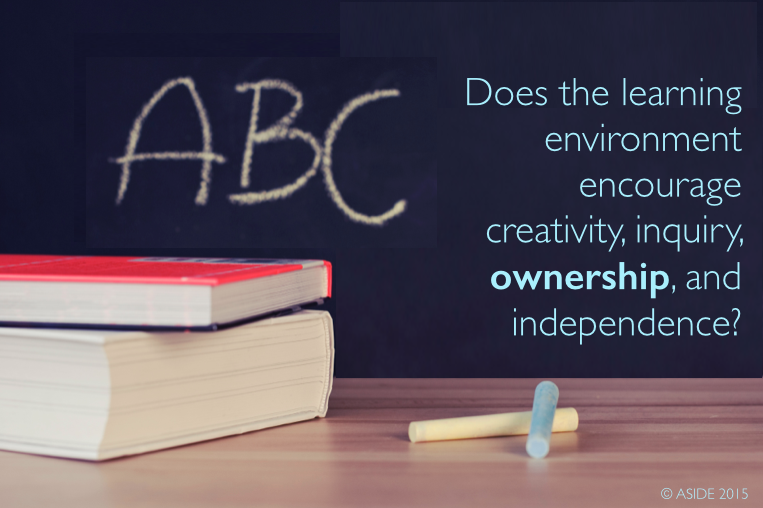
To inspire others is, after all, why we teach. We rely on inspiration as the fuel for engagement. We want to encourage an environment that fosters creativity, inquiry, ownership, and independence. Learners need a stimulating environment that fuels inspiration and a hunger for knowledge. This atmosphere refers to both the physical space and the personality of the teacher. Is the room stimulating and engaging? Is the layout flexible and complementary to the learning? Furthermore, is the temperament of the teacher encouraging, with an authentic sense of optimism about the journey the learner and the educator are about to take together?

It is not about efficiency and compliance; instead, it is about things like mindset, mood, mechanisms, measurement, and momentum that push the critical thinking process in order to extract new ideas. What is the tone of the instructor's language? What is the tenor of the student-teacher relationship? A bit of humor, for example, can be key to keeping the mood light and productive. A sincere repartee can make the minutes tick by with less tedium and maybe even some anticipation.

Source: ASIDE 2015

The more interdisciplinary, collaborative, and challenging approaches we use, the greater the chance to develop individuals that are confident to take risks. In this vein, teaching and learning is a partnership. A conversational style or technological savvy can help validate students’ daily experiences and show an effort to connect to their worlds – to what is important to them. This connection stems from mutual trust. Students want to trust that their teachers are laying out clear expectations, that their grades are based on fair assessments, that their learning is in the hands of an expert. If students don't trust that we as teachers are going to keep our word, treat them with decency, and give them the benefit of the doubt, then they will tune out everything else we try to communicate.

Today, learning is no longer limited to the teacher as keeper of the knowledge, nor to the moment with little connection to the future. It has to be deeper; it is about understanding. We want students to be more like hunter-gatherers, who constantly search for anything that interests them and who share it with the world. Life-long learning is far more like the migrating hunter-gatherer, and technology has opened that door. 

We hope to harness that energy, that inspiration, and that understanding of the power of connections to explore ideas. Our hope is to tap a learner’s inspiration and creativity so that they develop as innovative thinkers and knowledge seekers.

As teachers, we want to engage students:
  • To think like designers to transform the way they learn and look at the world
  • To develop flexibility in their thinking about ways to learn, and to tap their curiosity
  • To grow to be open-minded individuals who are knowledgeable about historical events
  • To gain confidence about what they know to share their understanding and enthusiasm for history and geography with others
  • To help them develop a curiosity for learning through the creation of their own work
  • To provide a range of choices for them to visually map their ideas to realize there is more than one way of seeing
  • To design curriculum to meet the information, technology and new media literacies needs of today's learners through current best practices that incorporate digital learning, technology integration, and social media
  • To develop flexibility in their thinking about ways to learn, and to help them feel comfortable with being uncomfortable
  • To promote honest discussions about disparities in society such as race and class to promote empathy for our differences
  • To recognize, value, and assess the many diverse ways children learn and how to meet them there

Saturday, September 26, 2015

When Grammar Is Animated, Usage Sticks

Source: TED Ed
We are huge fans of TED Ed: Lessons Worthing Sharing. The short, animated videos on a variety of topics deliver the perfect dose of information to help students with content areas. Because educators write the scripts for these animations, they hit that sweet spot of just enough to make the point while engaging the eye as well. We also routinely publish some of these videos that don't necessarily fit into our curriculum on our Humanities Enrichment Tumblr. As a result, our students have become big fans as well.

This summer, TED published a host of videos about grammar that we thought were extremely helpful with our learners. Two deal with punctuation, and the others talk about word usage. Emma Bryce is the author of three of the four, and she has a real knack for simplifying tricky grammatical problems.

When To Use Apostrophes 

In the first video, entitled "When To Use Apostrophes," educator Laura McClure reviews the sometimes complicated usage. The visuals make it easy for learners to understand.


How To Use A Semicolon

Emma Bryce's's video called "How To Use A Semicolon" explains the correct way to use the semi-colon, and the animator, Mark Storer, creates a playful character that knocks out periods as if in an arcade game. She "clarifies best practices for the semi-confusing semicolon."


When To Use Me, Myself, and I

In Bryce's second video, she addresses "When To Use Me, Myself, and I." Once again, she skillfully clarifies the different role each one plays in a sentence, even though all three refer to the same thing.


How Misused Modifiers Can Hurt Your Writing

The last Bryce video, called "How Misused Modifiers Can Hurt Your Writing," follows in the same vein as the others. She uses her expertise to explain how misplaced modifiers create ambiguity. The animation makes it easy to see how words, phrases, and clauses in the wrong places create problems instead of adding helpful information.


Friday, September 18, 2015

Talk About Peace For Just One Day, Or More!

Source: Postcards For Peace
This Monday, September 21, marks the thirty-third anniversary of the United Nations International Day of Peace that invites all nations and people to cease hostilities by commemorating the day through awareness on issues related to peace. In our effort this year to bring mindfulness into our curricula, we see this day as an ideal place to connect our year-long endeavor to develop kind, empathetic, young citizens of the world.

We see taking the time to make room to recognize the importance of peaceful, non-violent solutions as imperative to learning. It’s worth every minute to talk about it, particularly in today’s world. The resource materials listed in this post provide a multitude of options for educators to integrate the International Day of Peace into classroom instruction.

Source: Peace On Day

Peace On Day, founded by Jeremy Gilley in 1999, is a good place to start for free, educational resources and curriculum guides. Check out its “Peace Projects” page for curriculum ideas that connect to subject areas with links to Postcards For Peace, Face To Faith, or Pinwheels For Peace.

Postcards For Peace’s mission is to improve the well-being of those people around the world whose lives are affected by violence or prejudice by promoting change and offering hope, support, and compassion through sending postcards of goodwill.

Its short, introductory video is just right for introducing the project to young learners, in addition to promoting writing and creativity. Download the postcard template, or make your own. Either way, it’s a wonderful opportunity to raise awareness with students through acts of kindness.


Postcards For Peace - An Introduction from Postcards For Peace on Vimeo.


Source: Kids For Peace
The last resource we’d like to bring attention to is the website called Kids For Peace. Its mission is to promote peace through youth leadership, community service, global friendships, and thoughtful acts of kindness. The Peace Pledge in this post can be easily downloaded from its website.

If you can do nothing else this Monday, try to have the students take the pledge. We are hoping to have everyone at our school take part in this. Kids For Peace also has a simple “Peace Day Challenge” to promote acts of peace. It’s perfect for any age level.

Source: Kids For Peace


Sometimes we feel crunched for time to cover course material, but sometimes the right thing to do should force us to stop for something so important as PEACE!

For other resources, please see:

Thursday, August 13, 2015

“The Understudent” — Notice The Kids Waiting In The Wings And Turn Every Child Into A Star

Source: ASIDE 2015

Every teacher knows the high-achieving students in his or her classroom. These are the trusted “high verbal” pupils who raise their hands, who answer each question, who quote the night’s reading, and who ferry the conversation. It’s a tacit trust between educator and child — the rewards are mutual. The lesson can proceed according to the teacher’s design, and the extroverts can succeed according to the traditional model.

But what about the introverts?

What about the “low verbals”?

What about the children who read the homework, who complete the worksheets, who memorize the vocabulary words, who post their projects, and who code their webpages — but who don’t speak up?

Most of a typical class is a chorus. Most of the kids who fill the seats and laugh at the jokes and fulfill their studies do not win awards. They do not give speeches at graduation. They do not take a bow with an audience on its feet.

Source: ASIDE 2015

The majority of learners will not play the leads. They will fill the background and be part of the cast. They will not see their names on the marquee, and they won’t even think to deserve it.

If school is a stage, then few actors will sing the solos or shine in soliloquies.

Most kids will be understudies — or “understudents.”

They will know their lines, they will be at every practice, they will work like heck — and yet they will receive little recognition. Because that’s how life is. And when they do step away from the ensemble and raise their hands to give a correct answer, it will be a surprise, an anomaly. 

The greatest challenge, therefore, for classroom teachers is to identify the talent waiting in the wings. Who is lurking behind the scenes? Who is quieting her voice within the chorus? Who is restraining herself within the dance?

Somewhere, a student just needs a break, some encouragement, and a teacher who believes in him to break out and become a star.

Think about the Tom Bradys and the Kurt Warners who needed a first string player to falter just so they could have a chance.

Source: ASIDE 2015

Too many times the demands of high stakes testing and rigid teacher evaluations throw educators into survival mode, where they can barely keep their own heads above water, much less look out for a glimmer of light among their docile classrooms.

But that’s the job. That’s the key. Getting to know each child on a personal level is more important than drilling rote facts into their heads. All of us can think back to the mentor who believed in us, who pulled us out of our comfort zones.

As the new school year gets underway, one of our resolutions is to seek out the understudents. We also strive to recognize the kids with underparents. They don’t make a fuss, they don't complain, and too often, therefore, we attend to the squeaky wheels.

But the modest geniuses in our midst need us more than ever. If we don’t pluck them from obscurity, then they may end up seeing themselves as members of the throng — humble nodders in the choir, content not to speak up, not to dare, not to lead, and not to share all of the insights within their quick and boisterous minds.
Related Posts Plugin for WordPress, Blogger...


Pin It