With the continual barrage of news about gun violence in America, it's important that we use all available resources to help students give context to content, and visualizations help us do that. This motion graphic titled, 2015: A Year In Mass Shooting and produced by The Washington Post, is a powerful tool to educate young people about this issue. The headline, "374 mass shooting in 365 days in one extraordinary graphic," travels across the calendar year, pausing only once for the longest period without a shooting. As you watch, the headlines from newspapers around the country appear as the timeline progresses, but it is the voices from the 911 calls that capture the enormity of the human toll.
This motion graphic could easily be tied into any media or news literacy lesson using the headlines connected with the timeline of events. It is worth the watch with middle and high school students, and it is guaranteed to invite and spur discussions about the topic.
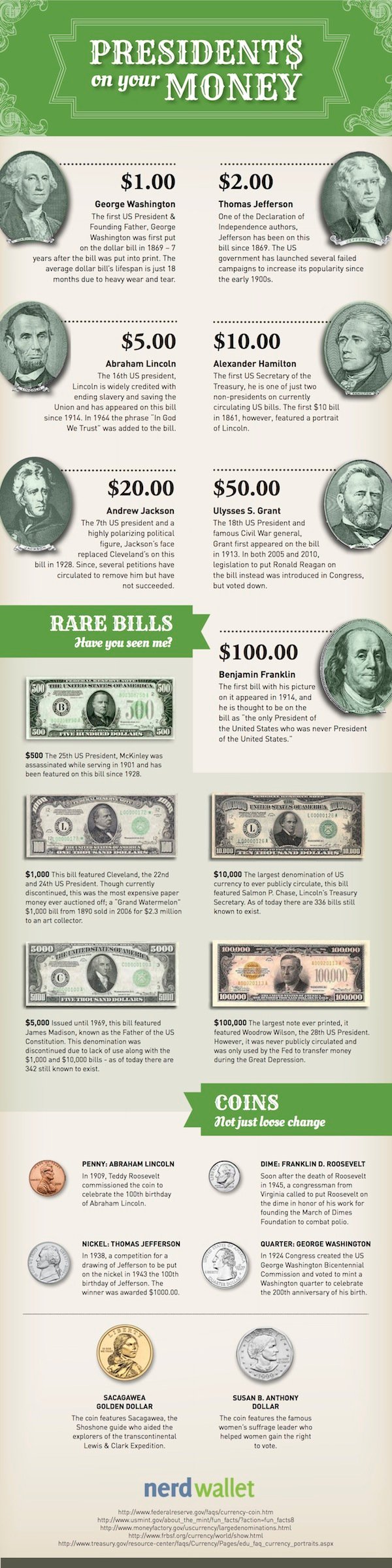
Who is on the 10 dollar bill? Who is on the 100? The 1,000? 10,000?
For the record, it's Alexander Hamilton, Benjamin Franklin, Grover Cleveland, and Salmon P. Chase. Only one of them is a president, and he's an admittedly lesser known Chief Executive.
Most Americans use coins and dollars every day, but they can't tell you whose faces occupy their notes. Most people know who's on the penny (Abraham Lincoln), but they can't name who is on the dime (Franklin D. Roosevelt).
The one thing, however, that all Americans intuitively know is that all of these etched and sketched faces are of white men. Why aren't there any women on U.S. bills?
Especially today, as the U.S. Mint is rotating images in its 50 State Quarters and its President $1 Coins, it seems inexcusable that none of the nation's women leaders are celebrated on our currency.
One group is trying to change this — and they're getting a lot of buzz. News stories this week featured the organization "Women On 20s," which is trying to replace Andrew Jackson on the 20 dollar bill with one of 15 inspiring women who championed freedom, voting, rights, medicine, and justice. Although Jackson's legacy reaches to the War Of 1812 and Big Block Of Cheese Day, he is largely remembered for leading the Trail Of Tears and the Indian Removal Act. Surely the country can honor a hero who did more to elevate the progress of the aspirational.
March is Women's History Month. The conversation around women's exclusion from patriotic displays is critical toward continuing the conversations about equality. This campaign, led by Barbara Ortiz Howard, is trying to gain enough signatures on its petition to inspire action by the White House. You can vote for the candidates and add your name to the petition at the website.
The spotlight on the 20 dollar bill's likeness offers a valuable opportunity to blend in other activities about financial literacy. This moment invites relevant lessons in elements of U.S. currency, including national leadership, image symbolism, Latin mottos, serial numbers, Treasury secretaries, counterfeit prevention, the U.S. Mint, and the Federal Reserve.
For other ideas about teaching financial literacy, we recommend:
This summer we’ve seen unprecedented violence and conflict, from our own backyard in Ferguson, Missouri, to the Ukrainian-Russian border. We’re sure that our learners have seen it, too. Wherever the conflict is, you can rest assured the media is there in full force as well.
The sound bites, prompts, replays, jolts per minute never end. The hyped negativity abounds with each new event. The good news is relegated to filler material that is never enough to make anyone feel good for long. No wonder parents are reluctant to let their children watch the news. In some ways our media is like the Capitol of Panem in The Hunger Games spicing up the story to keep the masses engaged. In the competition for viewership, ratings matter.
So what is Peace Journalism? The principal founder of the concept is Johan Galtung. He claims that our common daily news should be classified as War Journalism, because it tends to present conflicts as endless battles, or war. According to the Center for Global Peace Journalism, the practice of “Peace Journalism is when editors and reporters make choices that improve the prospects for peace.” These journalists carefully choose their words to create an atmosphere favorable to peace in order to make non-violent solutions more visible and viable.
Now more than ever we need to include discussions about war and peace journalism as part of media literacy instruction in our classrooms. It's important to help learners sift through messages from the media to find ways to change the view from a culture where aggression sells to one that diffuses turmoil by finding commonalities in humanity. By guiding students to seek solutions to conflicts, they become better peacemakers and peacekeepers. If we can flip classrooms, let’s get kids to flip the news to look for positive ways to present current events.
The following video was created by Oded LevRan as a project in visual communication studies at Holon Institute of Technology. It’s called Chickpeace. It presents the main principles of Peace Journalism using hummus as an analogy to reality that this is a staple dish for both Israelis and Palestinians.
Depending on grade level, students could take a topic, event, or place and present it as a way to build common ground. Aiding students in this type of endeavor teaches them the art of framing a topic around a positive approach to the world around them. Using reframing techniques, they can take an existing report and come up with a way to down play the hostility to foster a greater understanding. As always, teaching students to deconstruct messages, call out biases, or highlight sensationalized reporting builds stronger media and news literacy skills.
In light of the world events, sometimes it is difficult for our students to comprehend just how deep-rooted in history conflicts reach. Many of them don’t have the background in history to understand the dispute over the control of Jerusalem or the origins of the caliphate in Islamic history. Even fewer realize that the region of the Middle East has been wrought with turmoil over land ownership dating back to the days of Mesopotamia.
Jerusalem Explained, produced by Ph.D. Comics, is one of the best videos that we’ve come across to illustrate the 3000-year-old history of The Temple Mount as one of the most important religious sites in the world. It describes the constant battle to dominate it. We’ve used this in the classroom with our students, and its clear, uncluttered narration of historical facts lays out this extraordinary fight for power of this piece of land in the name of religion.
The most recent conflict involving the militant group ISIS (Islamic State in Iraq and Syria) began with the civil war in Syria and has now spilled over into Iraq, with the fear that it might incite further instability in other areas of the Middle East. One resource that is helpful here is the motion graphic entitled Iraq Explained: ISIS, Syria, and War, which provides an overview of the history of the conflict. It is a bit simplistic, for which it apologizes, but it's a good resource to use with upper elementary and middle school students.
Pair this with the video from The Wall Street Journal called Iraq: ISIS Sparks A Middle East Crisis, Explained to hear a different approach about the topic. Using multiple sources helps students see different points of view in delivering information. Students can look for similarities and discrepancies or take note of what types of facts were omitted. Various resources can clarify or call into question the accuracy of content, reinforcing news literacy and the role of journalism in reporting events.
Much has been documented regarding ISIS belonging to the Sunni sect of Islam with a mission to reestablish the Islamic caliphate of the medieval era. Both Sunnis and Shiites (Shia) belong to the Islamic faith. The struggle between these two groups occurred after the death of Muhammad in the sixth century in a dispute over who should be his successor. It’s about power, not religion. The difference is that Shiites believe the leader of the religion should be in the bloodline of Muhammad. A good resource to help clarify the difference between these two groups is What's the Difference Between Sunni and Shia Muslims?
Unfortunately, the media's use of the word "medieval" implies a return to the Dark Ages of violence and fear that characterized most of
Christian Europe in the Middle Ages rather than the Islamic Empire. It is taken out of context. Ironically, the Islamic Empire of the medieval world was extremely advanced in trade, science, and medicine, and it was dedicated to the preservation of knowledge, with Golden Ages under both the Umayyads and the Abbasids in Spain and Iraq. Women and children had rights, and science was separate from religion, unlike the Christians in Europe who imprisoned Copernicus and Galileo for going against church doctrine. The Muslims showed tolerance to Christians and Jews, because they were considered “people of the book,” meaning the Bible. This in not what ISIS wants.
The context for content makes a difference, and we want our learners to know that. The deep-rooted conflicts of today are about gaining power, using religion for justification. We need learners to see the difference.
Just how many times did the news media make mistakes in reporting the tragic events at the Boston Marathon or the ricin-laced letters to government officials? The answer is: too many. Between the implicit bias repeatedly stated on CNN that law enforcement officials were looking for a "dark skinned man, possibly African American" in a dark hooded sweatshirt, to the misinformation about the certainty of the letters testing positive for ricin, it is no wonder that our students were confused about the facts.
The Huffington Post reported Al Sharpton calling John King's comments on CNN about a "dark-skinned male" shameful, and Politico described it as "the media's marathon meltdown." The implicit bias in reporting the Boston teen, Salah Eddin Barhoum, as a bombing suspect on the Internet and the front page of the New York Post was front and center. This young man was afraid to leave his house. All of this harkens back to the Richard Jewell case at the summer 1996 Olympic games in Atlanta, Georgia. Jewell went from heroic security guard to suspect and then back to hero. The media was ruthless in its pursuit of Jewell, who was innocent all along.
Given all of these scenarios, we decided to make a concerted effort to help our students better understand the news. To do this, we used several videos from the Newseum Digital Classroom. Each of the dozen video lessons available for education is an excellent starter for an open and frank discussion about problems in reporting. The site also provides a list of essential questions for each video to use as a guide.
The first video we showed was "Getting It Right." It documents many of the errors in fact that have occurred over the last several decades. The kids were in awe over the number of mistakes made by the media, and perhaps the most impressionable was the error about the assassination attempt on President Ronald Reagan. They were equally receptive to the video on "Bias" and the often lack of objectivity in reporting the news.
Most students, and perhaps adults, don't realize that the news media is controlled by a small group of companies. The competition for top ratings, for being first, or for getting exclusives can push the need to rush a story onto the air without due diligence in checking the facts.
The infographic from FastCoDesign shows that 90% of media is produced by a handful of "Mega Companies," making the competition for viewership fierce. The consolidation of the news industry went from 50 companies in 1983 to just 6 in 2011. Perhaps more outstanding is the statistic that roughly 232 media executives control the media for approximately 277 million Americans. That's power, and it's all the more reason that we need to have our students question the news for accuracy and integrity.
Today, these news agencies are not only competing against each other, but also against individuals using social media. We don't have to wait for the evening news to get the scoop. Most often, someone has already tweeted it out in real time. Take a look at the infographic "Social Media and News Consumption for 2012" from State of the Media, from the Pew Research Center's Project For Excellence in Journalism.
There's no denying that mobile devices and the social media factor have changed the way we get the news. Additionally, our students could easily be apart of the "news-making." The idea that information can surface from anywhere is all the more reason to constantly encourage our students to be vigilant about the source of the stories. This is no different from the skills we teach them when they're researching for our classes, and we should build these same skills into their learning to decipher the news for fact and fiction.
Interestingly enough, within one year, the outlook regarding the news has changed again. In the updated study, it's apparent that economics is a major player in the news industry. Have the students compare the "2013 The State of the News Media: The Challenges Intensify" infographic with that of 2012.
Lastly, the video "Why the News Isn't Really the News" is a thought-provoking look at how news agencies, or the "mega companies," get the latest information. It's a cynical look at the news-making from Ryan Holiday, the author of Trust Me, I'm Lying: Confessions of a Media Manipulator. In the video he "shares a bit about
how he has manipulated media to get bogus, anonymous stories to the
front-page of news media outlets." He questions whether news stories
can be trusted since the way news outlets get their stories is flawed. Holiday leaves us with the thought that "the news may not really be the news at
all."
One thing is certain, if we want our students to contribute to the news or challenge its validity, we need to make it an active part of our classroom instruction on all grade levels. Questioning the news is current events at its core.


)