Showing posts with label classroom. Show all posts

Monday, March 13, 2017

Why Multitasking Is A Myth AND Bad For Our Children

Source: ASIDE 2017

Today's students live in media-dominated bubbles. They stream Netflix, check Snapchat, Facetime friends, and scroll Instagram  simultaneously on laptops, iPads, and phones — all while purporting to do their evening homework. Parents tell us that homework now takes five or six hours a night for their children. But candidly, most of our parent conferences end up being conversations about how to wrestle devices away from their kids. Families acknowledge that more often than not, their sons and daughters are in bedrooms with doors closed and with devices on full blast. It's a mystery how much "work" is actually being done.

Source: NBC News

That's because today's media-saturated world demands multitasking to parse the competing inputs. "Multitasking" seems like a badge of honor for modern professionals and learners. But for most children and adults, multitasking is a myth that deserves to be disproved. Multitasking by its definition relies on interruption. It (wrongfully) claims disruption as a blessing. Countless scientific studies have refuted this premise. Instead, every endeavor benefits more from full attention, not fractured thought. Every test, quiz, or homework assignment benefits more from dedicated study, not digital disturbance.


A helpful video from NBC News tries to make sense of this contemporary obsession with multitasking. The scientists quoted in the clip argue that monotasking is in fact more vital for brain development. They note that interruptions of fewer than three seconds can double the rate of errors on simple tasks. Multitasking can lead to a difficulty in ignoring irrelevant information and in memorizing facts, both of which are crucial for young learners.

Source: ASIDE 2017

Here are some other articles that provide terrific ideas for teachers and parents about how to negotiate the multitasking impulse in our children:

Thursday, August 13, 2015

“The Understudent” — Notice The Kids Waiting In The Wings And Turn Every Child Into A Star

Source: ASIDE 2015

Every teacher knows the high-achieving students in his or her classroom. These are the trusted “high verbal” pupils who raise their hands, who answer each question, who quote the night’s reading, and who ferry the conversation. It’s a tacit trust between educator and child — the rewards are mutual. The lesson can proceed according to the teacher’s design, and the extroverts can succeed according to the traditional model.

But what about the introverts?

What about the “low verbals”?

What about the children who read the homework, who complete the worksheets, who memorize the vocabulary words, who post their projects, and who code their webpages — but who don’t speak up?

Most of a typical class is a chorus. Most of the kids who fill the seats and laugh at the jokes and fulfill their studies do not win awards. They do not give speeches at graduation. They do not take a bow with an audience on its feet.

Source: ASIDE 2015

The majority of learners will not play the leads. They will fill the background and be part of the cast. They will not see their names on the marquee, and they won’t even think to deserve it.

If school is a stage, then few actors will sing the solos or shine in soliloquies.

Most kids will be understudies — or “understudents.”

They will know their lines, they will be at every practice, they will work like heck — and yet they will receive little recognition. Because that’s how life is. And when they do step away from the ensemble and raise their hands to give a correct answer, it will be a surprise, an anomaly. 

The greatest challenge, therefore, for classroom teachers is to identify the talent waiting in the wings. Who is lurking behind the scenes? Who is quieting her voice within the chorus? Who is restraining herself within the dance?

Somewhere, a student just needs a break, some encouragement, and a teacher who believes in him to break out and become a star.

Think about the Tom Bradys and the Kurt Warners who needed a first string player to falter just so they could have a chance.

Source: ASIDE 2015

Too many times the demands of high stakes testing and rigid teacher evaluations throw educators into survival mode, where they can barely keep their own heads above water, much less look out for a glimmer of light among their docile classrooms.

But that’s the job. That’s the key. Getting to know each child on a personal level is more important than drilling rote facts into their heads. All of us can think back to the mentor who believed in us, who pulled us out of our comfort zones.

As the new school year gets underway, one of our resolutions is to seek out the understudents. We also strive to recognize the kids with underparents. They don’t make a fuss, they don't complain, and too often, therefore, we attend to the squeaky wheels.

But the modest geniuses in our midst need us more than ever. If we don’t pluck them from obscurity, then they may end up seeing themselves as members of the throng — humble nodders in the choir, content not to speak up, not to dare, not to lead, and not to share all of the insights within their quick and boisterous minds.

Sunday, July 14, 2013

Technology & Specialization - How To Cultivate Master Teachers?

Source: Washington Post, ASIDE
As more and more states opt out of the Common Core requirements, the question mark looming over U.S. education grows more and more daunting. Each evening our Twitter PLN lights up with creative ideas about project-based learning, flipped engagement, and BYOD flexibility. But these are not the national norms. The morning news, in fact, registers exactly the opposite, with more and more stories about regrettable school closures, bungled teacher ratings, and bubble-sheet scandals.

The coast-to-coast consensus on a direction for student learning seems as unattainable as ever. Public, parochial, independent, charter, and home school options are all good-faith models of teaching and learning. But it's like the debate over school vouchers -- with so many options, who is being left behind?

The Common Core initiatives at their best are attempts to elevate skill expectations and to implement desired outcomes across the country. At their worst, however, these new standards simply replace old standards. One size still fits all, and rote testing becomes both the symptom and the prescription for the lingering malaise.


We recently came across a motion graphic from Public Impact, made in conjunction with Column Five Media, which offers several novel proposals for upending America's schools. These suggestions differ by focusing on the teacher. They imagine how the best educators could apply their training and their time to best effect. We don't yet know much about Public Impact as an organization, and we're trying to read up more about the group's point of view. The Advisory Team does feature some respected names, and as a stand-alone video, the clip presents notions worth considering.

Source: Public Impact

A few of the stated aims include:
  • Specialization - where the single-teacher, contained elementary classroom is broken apart
  • Multi-Classroom Leadership - where teacher-leaders are encouraged to guide bottom-up teams
  • Time-Technology Swaps - where the flipped or MOOC model is brought back into the classroom to maximize teacher time allocation
According to Public Impact, these changes could instill an "Opportunity Culture," which would subsequently lead to higher salaries. We like this scheme more than, say, the "Teachers Pay Teachers" construct, which turns educators into corporations. Some of the Opportunity Culture details do seem still in the conceptual phase. It's also unclear how exactly a small handful of teachers would be labeled "expert" among the larger pool of "other" teachers. But as fuel for the continued educational discussion, these propositions seem worth adding to the fire.

For other resources, please check out the following:

Monday, May 7, 2012

Classroom Design - Feng Shui For Learning

In the past few years, we've been paying closer attention to our classrooms. We've been making time to rearrange our students' desks based on each day's goals. Some experiments have been more successful than others, but we've found that the class arrangement undoubtedly aids learning.

Room layout ideally should be an extension of the learning. Adaptable designs allow for differentiation. They avoid a repetitive setting and instead customize the space for lessons. Redecorating enlivens the children's experiences and provides flexible room for technology or discussions. Feng shui harmony translates to the classroom, as the arrangement matters.

When students enter a classroom and encounter a new configuration, they appreciate both the unpredictability and the predictability. They like the change, even if unexpected, because it validates the importance of their daily scene. Students begin to anticipate the learning by the day's arrangement, which itself is a decoding, thinking skill. Keeping a classroom fixed is not inherently bad, but it does suggest that information delivery might be fixed, too. Not updating a design is like not changing a bulletin board or not refreshing a homepage -- certainly not a crime, but not ideal either.
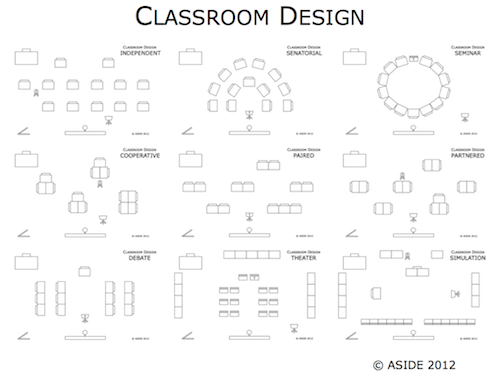
In our class, we are lucky (or unlucky) enough to have conventional, lift-top desks with separate wooden chairs. These end up giving us more flexibility than would rigid tables, which seem popular in some classrooms. We typically keep our teacher's desk in the back left corner. The SMARTboard is at the front. The designs below are a few of the layouts we've found to be effective:
Senatorial seating is our students' favorite design. They know the day will be mostly discussion-based, with plenty of visuals shared on the SMARTboard. The podium in the front is mostly pro forma, since we generally wander the classroom. Even in note-taking from PowerPoint or Prezi, the cozy, scalloped layout welcomes each child into the conversation and obviates the need for assigned or "preferential" seating. Students also know there probably won't be a pop quiz that day, given the close proximity of desks.
The independent template was once called "traditional." It used to be the teacher-driven model where students alienated themselves spatially in order to focus on the professor's lectern. This plan has been (perhaps unfairly) discredited by contemporary theory, and the repetitive lecture format is no longer trumpeted. The basic design, however, has taken on new life. Now the spacing allows children to work independently at 1:1 laptops or iPads. The room for movement invites self-directed work and hand-drawn projects. While students are exploring, the teacher can circulate freely, moving a small stool from desk to desk if desired. This evenly spread blueprint also allows for assessments, since authentic, non-plagiarized evaluations are still essential.
The seminar style provides the benefits of colloquy and sharing. Book discussions and writing workshops suit this format. The teacher sits at a chair in equal status as the students. No one is designated as the "leader." Socratic sessions, collaborative essays, and personal exchanges are all ideal here.
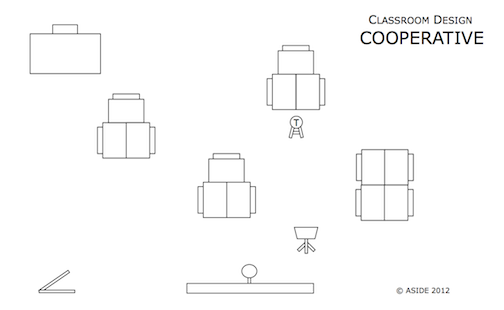
Cooperative groups obviously offer many benefits. The students instruct one another and solve problems in collaboration. The teacher can sit with whatever group needs extra attention. Differentiation, therefore, is essential in creating combinations, which will likely change depending on the day's activity.
Pairs are useful when students are sharing a laptop or are dissecting a text together. We happen to have an odd number of students, so the coupling is not always perfect. But the paired design is often an optimum arrangement for examining primary sources, handling manipulatives, or creating projects.
The partnered format is not the same as the paired design. Here, students face each other, which emphasizes face-to-face interaction. Again, the teacher can move from group to group, while the students work as lawyers and witnesses, Democrats and Republicans, or Montagues and Capulets.
In a debate, the teams need physical separation to plan their strategies. They also need clear sight lines to the opposing squad. The teacher at the podium has a minor role, as a student preferably would serve as the moderator at the desk. The SMARTboard is handy to record key points or to keep time.
Often our best classes occur when students don't take a single "note." In these cases, they might not even need desks. The theater design allows them to sit closely in chairs, without an artificial divide. The desks are pushed against the walls. The teacher becomes a spectator, as the group watches a film, takes turns at the SMARTboard, interacts with web 2.0 tools, or appreciates a peer's oral presentation.
Simulations turn the students into role-players, and the classroom can be made to mimic real-world contexts. We annually reenact a criminal mock trial with our seventh-graders, so this arrangement features a witness stand, a judge's bench, an attorney's podium, and council chairs. The desks are again against the walls. Other room role-plays could include a Congressional vote, a news broadcast, a Medieval castle, or a frontier campsite.

Update: Classroom Architect is a free, easy, interactive web tool to design sample layouts and move furniture in a virtual floor plan for your classroom.
Related Posts Plugin for WordPress, Blogger...


Pin It