Our students fell in love with our refrain that "Google is ubiquitous; it's everywhere" when they realized that whatever they typed in their Google Docs showed up on any device. Now with Google Classroom, they especially see the connection that everything they need is synced in one place by multiple teachers. For educators, it makes hybrid learning streamlined for both remote learners as well as for those in the classroom, particularly when this situation remains fluid. Many know that the students are always checking their emails and Classroom with little to do because of the current situation.
So when we recently sent out Google's new project called the "Blob Opera" to Classroom over the winter break, the students happily started making their own four-person, musical creations. Blob participation depends on the producer. It's simple and easy to launch. Compose an opera with blob vocals ranging from bass to soprano in just minutes. It's also easy to share via Google Classroom as a teacher, and students can send their creations in the same way as an announcement to their peers.
For more information, check out Fast Company's article on how to manipulate the blobs to create a symphony of your own chamber music. Google did not use any recordings of actual singers. Instead, it built the system by recording "hours of classic opera singers, and used that data to train an AI model to know and mimic what an opera singer should sound like."
It's a nice way to end a crazy year by bringing in a new one with a little joy and creativity. If you're not actively checking Google's Art and Culture resources, start today.
If you haven’t yet seen them, you will soon. In a matter of weeks, the latest kid craze has emerged, twirling in the hands of every middle schooler. Boys and girls alike now arrive in class with a plastic spinning whatchamacallit that they whirl ad infinitum throughout the day.
These popular trinkets are called fidget spinners, or some variation thereof. They are not new, but they are the newest trend. They feature either two or three prongs jutting out from a middle circle that, thanks to weighted bearings or loose-fitting rotators, allows the device to spin for long lengths of time between the thumb and forefinger. Some may have interchangeable parts. Some are made of plastic or steel. But all of them are currently occupying the idle minutes of children, many of whom have invented clever spinning stunts and tricks that can be seen across YouTube.
Source: ASIDE 2017
As with all kid crazes, it’s doubtlessly true that some teachers and schools are already in the process of outlawing them. Unfortunately, there is sometimes the impulse to ban first, think second. Pokemon cards, for example, have been largely prohibited from elementary classrooms, because they potentially lead to distracted and upset children. We would argue (as would one of our students, who wrote an editorial for our school newspaper) that teachers should help kids work through their interpersonal issues when a child, for example, gets upset after a Pokemon trade gone awry.
Perhaps fidget spinners are distracting. Perhaps they are “toys” that should remain at home. We would urge schools, however, to please embrace the spinners. Please celebrate the outlets of vibrancy and restlessness. Our seventh-graders let us try them out, and gosh darn it, they’re pretty neat.
Here are nine reasons that fidget spinners are the best fad of the decade:
1. They activate the mind - Kinetic energy of the hands translates to synaptic responses in the brain. Even repetitive tasks, such as spinning a widget, engage the mind and let the imaginative juices flow. Exercising or taking walks has long been recognized as helping with learning. Fidget spinners offer micro-exercise, to stimulate thinking at a child’s desk.
2. They (might) help distractible kids - A broad and worthy debate is taking place about whether these spinners truly help children with ADHD. Some argue that the trinkets are an outlet for excess energy. Others purport the opposite, that they distract rather than focus. Either way, all educators acknowledge that some kids are always going to lean back in their chairs and squirm in their seats. These toys do give active children an outlet to exercise their energy, spinning the prongs again and again and again.
3. They are harmless - At long last, here is a fad that is truly innocuous. Unlike bottle flipping (which makes a mess) or slime (which spreads its goo), these spinners have no injury quotient. They are all about one user and his or her play.
4. They are not about status - There is no prestige factor with fidget spinners. Unlike Ugg boots or Hamilton tickets, these are (relatively) inexpensive, available at local 7-Eleven stores. They are a novelty, a bauble, rather than a currency for popularity or exclusion.
5. They are non-gendered - Fidget spinners constitute one of the only trends in recent memory that is not boy- or girl-specific. It is not about cat headbands or jeggings or friendship bracelets. It is not about football cards or anime or numbers of Instagram friends. This whim is completely benign.
6. They invite creativity - Kids are currently figuring out clever and advanced ways to keep the widgets spinning. Take a look at YouTube to see all sorts of neat and inventive stunt.
7. They are personal - Twirling a plastic knickknack is an individual activity. There is no competition and no trading. Instead, the activity welcomes a sense of mindfulness, to center one’s thoughts for a moment.
8. They involve the hands - In a world of passive screen time and binge television watching and all-night video gaming, these spinners actually celebrate motor coordination. They keep the student moving, and they enhance the dexterity of actual digits, rather than digital electronics.
9. They are a single investment - Students only need one. They are not collectibles. They don’t require scrapbooking or updating or charm-braceleting. They are a one-time purchase, to be enjoyed as long as the fad lasts.
Adam Grant's book, Originals: How Non-Conformists Move The World, has vaulted to the top of best-seller lists since its publication last year. The book is a fascinating study of creativity, imagination, ingenuity, and success. It examines the conditions and case studies of standout individuals who embody vision and entrepreneurship. As a top-rated Wharton professor in organizational dynamics, Grant is a leading voice in studying what makes historical and contemporary figures unique in their influences.
Source: ASIDE 2017
Recently, our school held its annual Colloquium evening. Here, parents, teachers, alumni, and staff came together for a night of food and conversation to share ideas as adults. Like a book club, the Colloquium each year picks a thought-provoking publication to inform small-group exchanges. This year, we read Originals, and we were lucky enough to have Adam Grant himself phone in to our gathering to answer questions and inspire our audience.
We were surprised, however, in searching the Internet, to find very few discussion questions centered on the book. We wrote our own list of questions, both for the small-group conversations and for the author himself. We wanted to share our list, in case any book clubs or schools out there are reading Grant's terrific book about self-expression and innovation.
Essential Question:
“The last time you had an original idea, what did you do with it?” Did you “speak up and stand out”? Why or why not? (p. 13)
After reading the book, do you see yourself as either “creative” or “original”? Why or why not?
Adam Grant has his own definition of originality: “introducing and advancing an idea that’s relatively unusual within a particular domain, and that has the potential to improve it.” Do we have our own personal definitions of what it means to be “original”? (p. 3)
Do you think your current job or life role allows you to be creative? To be original? Why or why not?
Overall, did you feel that Adam Grant laid out a strong roadmap for originality, looking to the past for examples and to the future for methodologies?
Why do so many of us automatically accept the “default” options in life instead of engaging in research and making informed decisions for ourselves?
What do you think of Adam Grant as a writer, with his mix of narrative voice and scientific scholarship, and his interweaving of examples?
What did you learn from this book?
Which of the “Actions For Impact” in the last chapter did you find the most helpful? Which (if any) are you thinking of trying?
Adam Grant suggests that procrastination can actually help entrepreneurs build companies that last. How does society view procrastination? How can teachers or parents find ways to reward thoughtful, deliberate, and strategic procrastination?
Does a person have to be an “informed optimist” to be creative and/or original? Do pessimists make poor change-makers? (p. x)
How much “borrowing” is allowed before a dynamic and change-making idea becomes successful but not necessarily “original”?
How can we apply the phenomenon of “vuja de” to our own lives – seeing something familiar with a fresh perspective? (p. 7)
Are there other examples of people who enacted change by becoming “curious about the dissatisfying defaults” in our society? (p. 8)
“Practice makes perfect, but it doesn’t make new.” How does this statement inform our jobs as parents and teachers? (p. 8)
Do you agree that achievement crowds out originality? Because it brings a dread of failure?
In the end, after reading all of the anecdotes in the book, do you think originals crave risk or prefer to avoid it?
What are the advantages and disadvantages of the Sarick Effect? Where else in life might it be useful to start with the open admission of one’s weaknesses? Where might such a strategy be harmful?
How do we take into account the inherent difficulties and errors in self-assessment? Seventy percent of high school seniors rate themselves as above average in leadership skills, and 94 percent of college professors think they are doing above average work. How many of us view our children or ourselves as above average? Why? (p. 33)
How do you feel about Adam Grant’s note regarding the greater historical number of “creative” accomplishments made by men as compared to women? Is it a matter of time / freedom / access to producing a greater volume of output? Or is it a matter of “speaking while female”? (p. 37, 85)
If peer evaluations provide the most reliable judgments of new ideas, how can we be more open to genuine feedback?
How do you feel about the notion of “idiosyncrasy credits,” built up by “quirky” individuals to justify their creativity and earn them respect? (p. 67)
“Younger brothers were 10.6 times more likely than their older siblings to attempt to steal a base.” How do we think about risk-taking and risk aversion in our own lives? In our children’s lives? (p. 150)
Do you agree that praising character rather than behavior is the ideal strategy?
If “groupthink is the enemy of originality,” how can we avoid that trap in a culture that increasingly emphasizes collaboration and teamwork? (p. 176)
Do you agree that “dissenting opinions are useful even when they’re wrong”? (p. 185)
Is originality just creativity plus action?
Do you agree that “no one has the right to hold a critical opinion without speaking up about it”? (Ray Dalio, Bridgewater Associates, p. 190)
Does your current life include “critical upward feedback”? Would you like it to? (p. 203)
Do you agree that the better personal mantra is “I am excited” as opposed to “I am anxious”? (p. 216)
Raise your hand: Do you use Internet Explorer or Safari as your web browser? Do you feel more linear or patterned than Chrome or Firefox users? (p. 5)
What are some ways to take extreme risk in one arena and offset it with extreme caution in another?
Let’s talk about Seinfeld: Was it really original? Or just different? Or just smart? Are these the same things?
How do you feel about “The Positive Power Of Negative Thinking”? (p. 212)
In your book you talk a lot about risk-taking and potential failure – that achievement can crowd out originality because it brings a dread of failure. For us as teachers and parents, how can we assuage our children’s fear of failure in a culture that still values A+’s and college admissions?
Since Originals was published, have you come across any new people or companies that you wish you could have included in your book?
Schools by their nature are in the business of assessment. Can you give us any guidance in how to negotiate the inherent problems with self-assessing, for students and teachers, knowing the research that says most people think of themselves as “above average”?
You quote one of your former students, Justin Berg, as finding that, on average, “women make better creative forecasts than men.” Could you tell us more about this idea? How does it fit with the other interesting notes in your book regarding the greater number of “creative” accomplishments made by men as compared to women?
You write convincingly about the importance of peer evaluations in providing the most reliable judgments and the most helpful feedback about new ideas. Do you have any suggestions about how parents can apply this model to their daily lives? Or how teachers can do the same?
We liked your notion of “idiosyncrasy credits” in explaining why some people are afforded the respect to introduce new ideas, to deviate from expectations. Would you mind telling us more about this idea? Is it something we should all be trying – to be more idiosyncratic?
We were surprised to read that procrastination can actually help entrepreneurs build companies that last. It’s somewhat different from the message we often instill in our children, about advance planning. Are there ways that you recommend for teachers or parents to reward or encourage thoughtful and deliberate procrastination?
In thinking about writers, entrepreneurs, artists, and inventors, how much “borrowing” do you think is allowed before a dynamic and change-making idea becomes successful but not necessarily “original”?
Do you have any suggestions about how we can we apply the phenomenon of “vuja de” to our own lives – seeing something familiar with a fresh perspective?
You talk about the notion that “groupthink is the enemy of originality.” How can we avoid that trap in a culture that increasingly emphasizes collaboration and teamwork?
You rightfully note that many “originals” never act on their ideas. They conceive of bold or innovative notions, but they never act on them. What do you think holds them back? In other words, why some but not others?
“Practice makes perfect, but it doesn’t make new.” This was a particularly interesting line from your book. Do you have a sense of how this statement can inform our jobs as parents and teachers?
Could you tell us a little bit about what you are working on for your next project?
Out of all the organizations and individuals that you highlight in your book, is there one that stands out in your mind as being particularly unique it its story or its embodiment of a truly original mindset?
Okay, finally – let’s talk about Seinfeld. We here are New Yorkers, so of course we agree with your praise of the show. But after reading your book, we wonder: Was Seinfeld really “original”? Or was it just different? Or was it just smart? Are these the same things? How can we distinguish between those similar but different concepts of achievement?
Many thanks to Adam Grant for his generous time in speaking to us during our Colloquium evening. Also, we want to credit Natasha Chadha (@MsChadha92) for her terrific ideas in helping to draft these discussion questions. Finally, we want to thank Dolly Chugh (@DollyChugh) and Stefani Rosenthal (@StefRosenthal) for their leadership in staging such a successful Colloquium evening.
As our nation’s children head to back to the classroom, many schools find themselves trying to rein in kids’ summer impulses. Strict conduct policies are emphasizing rules and enforcing straight lines on students who are used to gamboling in backyards and lolling for hours.
Many Scandinavian countries, most brain science, and all veteran teachers would encourage the exact opposite. They would argue that instead of limiting play, educators should expand the amount of free time dedicated to socialization and creativity. Imagination itself is not learned, but it can be unlearned due to the drone of worksheets and mandates.
Source: ASIDE 2016
While many schools nationwide are reducing free play opportunities, our neighboring Patchogue-Medford district here on Long Island has actually doubled recess time from 20 to 40 minutes. In fact, a few Texas and Oklahoma schools now schedule recess four times a day. These changes are not capricious; they are part of studies such as the LiiNK Project, which has found that physical activity increases students' emotional well-being and reduces instances of bullying and stress. The American Academy of Pediatrics supports these findings with its seminal white paper about "The Crucial Role Of Recess In School."
Across the board, students, teachers, parents, administrators, kinesiologists, therapists, and test graders are all witnessing the positive outcomes of enhanced play time. The scientist Jaak Panksepp has devoted a career of research to answering two pivotal questions: Where in the brain does play come from? And is it a learned activity, or is it a basic function?
Source: ASIDE 2016
NPR has highlighted Panksepp’s studies, showcasing that play is deep and instinctive, shared across mammals, and integral to survival. Important social skills stem from play, in testing interactions, probing limits, and navigating hierarchies. In other words, play is primitive, the natural outcome of time and trust.
Children need this unstructured time to make mistakes and develop friendships on their own terms. The arena of the soccer field or the sand box is ideal in nurturing successful adults. Recess is not a privilege. It should not be an afterthought. It should instead be written into the students’ Bill Of Rights.
Otherwise, what are our playgrounds? Are they monuments to eras past? Are they the still testaments to the naivety of earlier generations? Are they just another hallmark of the sped-up modern day, the never-enough-time-for day, when the things we wish for are just that — wishes?
For other ideas about the importance of play, we recommend:
Born digitals deftly use technology; for them, it just is. Yet we constantly see discussions, blog posts, and articles about where and whether we should integrate technology, how it should be done, does it motivate learners, etc. We are decades past this discussion. Of course technology feeds motivation. What else would — filling in worksheets, taking linear notes, or sitting through text-laden PowerPoint presentations?
Education seems to view technology as something separate. It’s not for us, nor is it for our students. We use our devices all the time, and so do they. In fact, they approach technology fearlessly and can find workarounds with little trouble. Internet down? No problem. They set up hot spots using their phones to work on their iPads. Looking for contact information? No problem. They conduct a Google image search to connect to a LinkedIn profile. Need to send a direct message? No problem. They do it through social media. We've witnessed all of these scenarios with our middle schoolers.
So why do we now see a surge in kids regarding making things with their hands as so exciting? Simple. They rarely enjoy opportunities to do this type of work anymore in most classrooms across the country. Few students experience “free play.” They live in a play date world of scheduled activities and rarely take risks without a helmet and harness.
Physically designing, building, prototyping, and testing things they construct is the novelty, not the technology. Most of them have grown up using tech since infancy. It’s a no-brainer to search to find information or watch a YouTube video for ideas, tutorials, and entertainment. But to actually make something is the memorable part. It’s what John Spencer describes in his video entitled "Kids Need Vintage Tools."
Vintage does not mean old; instead, it refers to something of high quality and lasting value about a particular object from the past. We see the lasting value in balancing high tech with high touch in our curricula, and we make room every chance we can to incorporate it. This includes hand-drawing maps, constructing early farming settlements outside, or planning community villages. Our students may use technology in the process to document their work, but what they remember most is making it. They use vintage tools all right, including pencils, paint, and glue. They love it.
So while we applaud, integrate, and depend on technology using any device, in the end what we find is using tactile materials changes the way students feel about their creations. We don’t slight tech at all; in fact, we love it. We would argue that today's heightened interest in robotics is not in using the technology to program, but instead in actually watching the robots come alive. This applies to creating stop-motion movies, designing apps, and creating computer games. Each of these endeavors turns out a product in the end. The process in making any one of these, however, is the addictive part and the one that is most remembered. Making matters.
Our high tech born digitals may just thrive on high touch even more!
The library makerspace was in full bloom this year, giving our students an amazing opportunity to learn by doing. They were encouraged to use a variety of applications to explore different ways to demonstrate their academic abilities as they related to curricula thematic units. The finished products were anything but projects; they combined informational, visual, and spatial literacies, and they actively pushed students to think critically and solve problems.
Source: ASIDE 2016
As with any project-based learning experience, it required collaboration. The nursery, Kindergarten, second-grade teachers, and librarians worked together to design an interactive, hands-on unit to engage students on multiple levels throughout the process. The following projects represent a symphony of parts, but most of all, they could not have culminated into this extraordinary learning experience for the students without an incredible group of dedicated friends and colleagues.
Source: ASIDE 2016
Teachers Elizabeth Wakhale and Lori Zwick described it this way: “The nursery children worked in the library makerspace with librarian, Stephanie Temple, to transform everyday materials into upcycled instruments. The inspiration came from the book entitled The Animal Boogie, by Debbie Harter, where they listened to the sounds of the rainforest. Tissue boxes became guitars, oatmeal containers became drums, paper towel rolls became rain sticks, and egg cartons became bell shakers. Their imaginations soared, and the sky was the limit.” The children will play their musical instruments in their outdoor celebration of Earth Day and the rainforest in the campus amphitheater at the end of the week.
Source: ASIDE 2016
The students in Kindergarten used engineering skills to create blue prints of world landmarks by deconstructing the shapes of buildings, finding the materials they needed to build them, and erecting the structures in three-dimensional forms. Geography was an integral part of the learning process. The students studied the continents and made map keys to mark where each of the landmarks was located.
The Kindergarteners learned about community helpers with their teachers Marybeth Horne and Jessica Shippos. This project was a way for them to see how community builders must have worked together to construct important cultural landmarks. “It was amazing to see how the students carefully deconstructed the different geometric shapes for their blueprints to figure out they materials they needed to build their own creations,” said librarian, Stephanie Temple.
Source: ASIDE 2016
Source: ASIDE 2016
The second graders became urban planners and architectural engineers to answer the question, “Where Do People Live?” They used a variety of visual tools such as sketchnotes and mapping to plan their physical urban, suburban, and rural communities. This involved visually transferring a two-dimensional map into a three-dimensional environment.
The second grade teachers, Stefani Rosenthal and Jessica Raffaele, had the students document the communities by taking photographs on their iPads. They imported the images into the Book Creator app in which they reflected in writing on the needs of a community and the type of community in which they would like to live. It was a perfect combination of “High Tech, High Touch.”
Source: ASIDE 2016
Our “Build It” after school program was also a big hit. The whimsical robots and imaginary landscapes captured the hearts and minds of everyone. It was an amazing experience for the students to see their handiwork on display. It was the school hot spot for the week, with lots of photo opportunities with their creations.
Most of all, nothing limited their creativity. When the exhibition opened, the students could not have been prouder, nor could we.
Finding the optimum study technique is the holy grail for educators. Parents and teachers alike are joined in their quest to discover the most effective yet the most efficient process for helping their children learn. Countless conversations in the weekly parent-teacher Twitter chat (#ptchat), one of our favorites, have been dedicated to pinpointing the ideal strategies for evening study.
Several peer-reviewed scientific studies have actually conducted real-world experiments to determine which methods are the most successful. The terrific explainer video, "How to study smarter, not harder," offers some surprising findings about what helps children retain information. This animated infographic comes from Benedict Carey's book, How We Learn: The Surprising Truth About When, Where, and Why It Happens (Random House, 2015). An award-winning science reporter, Carey explains the benefits of daydreaming and distraction to amplify learning – both of which are anathema to the conventional thinking about nighttime study.
Carey clarifies that the brain is not a muscle. It doesn’t grow simply from hard work. Most educational theorists state that the more studying, the better – the more hours of focus, the deeper the memorization. Brain-based research, though, says the opposite. Consistency is often the enemy of learning. In fact, a control-based study proved that a simple change in venue can yield a measurable increase in the internalization of material.
Parents and teachers owe it to their children to take advantage of scientific findings to aid young people's development. If proven data points to more salient learning techniques, then the skill-and-drill mentality of flashcard homework deserves to be shuttered.
For more ideas about effective learning, check out:
Education is smack in the middle of an earth swell of change. No matter how hard the system tries to maintain a rigid set of evaluative assessments, something has to give. Otherwise, we will lose too many teachers over restrictions, and worse, too many young people who know that outside of school the freedom to learn, experiment, and create exists.
Source: ASIDE, 2015
Sure, we know that the fundamentals of reading and writing are key to understanding complex information. We are not advocates for throwing the baby out with the bath water. But perhaps the recent change in Finland to dump teaching subjects in favor of topics should send shockwaves through a system that constantly tries to reinvent itself with nothing more than new standards.
While we know that schools are not businesses, we also know that the insights Stefanovich tries to bring to companies apply to any institution with the desire to promote innovative thinking. His ideas and concepts cross over into any discipline. His fundamental formula:
I + C = I, or Inspiration + Creativity = Innovation
This equation also applies to education. We seek to inspire our learners to use creative thinking to come up with innovative ideas; likewise, we hope to do the same with our approach to teaching.
To inspire others is, after all, why we teach. We rely on inspiration as the fuel for engagement. Just like a business, we want to encourage an environment of productivity for learners. To do this, we can no longer sacrifice inspiration for efficiency.
Source: ASIDE, 2015
The framework behind LAMSTAIH includes five key drivers, including mood, mindset, mechanisms, measurement, and momentum to push the thinking and change the behavior in order to extract new ideas.
The concept behind each “M” not only provides a way for leadership to look at the needs of an institution, but it also helps to promote innovative ways of teaching and learning. Educational conversations circle around many of the same ideas.
So perhaps we could learn a thing or two by looking at more, including the insightful description of the three kinds of curators mentioned the book. On the one hand we have the traditionalist, who is the keeper of objects with the role of making sure that people of the future benefit from the collection of knowledge, and the Zeitgeist curator, who captures the essence of today and connects it to the not too distant future. This sounds like the role of the teacher. And then there is the hunter-gatherer curator, who constantly searches for anything that interests him or her and shares it with the world. Sound familiar? This represents most of the learners we teach.
Source: ASIDE, 2015
So where are teachers and learners as curators? More importantly, where do we want to be? At the moment, many educators are in the middle, yet our students outside of school are hunting and gathering.
Life-long learning is far more like the migrating hunter-gatherer, and technology has opened that door. We need to harness that energy, that inspiration, and that understanding of the power of connections to explore ideas. We can’t keep kids from exploring, connecting, and learning; we want them to be inspired, creative, and innovative.
We’re in the midst of our fifth season working with our elementary students on the entrepreneur project-based learning unit. Even with the flexibility in our curriculum to teach, we still find that each year it gets harder to get kids to extend themselves, to take a risk, and to dare to be different.
Not that a car commercial could change all that, but lucky for us, Cadillac launched its new ads during the Academy Awards to promote its latest luxury sedan. In all four commercials, the last frame appears with the line:
“Only those who dare drive the world forward.”
We wrote it on the board without the credit line. Surprisingly, kids, teachers, and even some administrators who visited the classroom remarked about the statement. Of course, we then gave credit to Cadillac. By not associating the carmaker with the word “drive,” it changed the interpretation of the quote, making it a far more powerful statement about human motivation.
Most of our students didn’t realize that the carmaker was a 112-year-old company, nor that the association with the word “dare” represented a company not afraid to reinvent itself by making connections with other innovators such as fashion designer Jason Wu, “Boyhood” director Richard Linklater, and Apple co-founder Steve Wozniak. It even promoted the social media connection with its #DareGreatly hashtag. Needless to say, it became our mantra for the spring. Those who dare to think, see, and do things differently change the way we think.
We piggybacked “The Daring, No Regrets” video from Cadillac with the motion graphic “What Is Innovation?”, designed by Rafa Galeano and written by Fast Company blogger David Brier. Brier’s post on the making of this video describes his own inspiration for the theme and the motivation to use his essay to make a motion graphic on innovation for others.
It provided our students with another view of how ideas, from the discovery of fire to their own electronic devices, came from the motivation of others who saw the potential in their creations.
Perhaps the last four lines of this video drive home the point we want our kids to understand:
"So what is innovation? Those other dots. The ones others miss. And having the certainty to know that the dots you see are not only valid, but necessary if the world is to move forward."
Providing opportunities for students to see the potential of others driven by need, or a desire, helps them to let go, to dare. We want them to not only see the possibilities of being an entrepreneur, but also to embrace the notion that it can be a reality. That’s when we showed them 11-year-old Lily Born’s Kangaroo Cup. That made the most impact on the kids and their ideas.
Lily wanted to build a better cup to help her grandfather who has Parkinson's disease. Lily's advice to fellow pre-teen entrepreneurs actually applies to all ages: "Don’t freak out if you screw up or fail, because you’ll fail a lot before you get it right." She also says, "Don't be afraid to ask for help." She used her ingenuity to rethink how best to change an ordinary cup to help others. She dared to make a change and never gave up on her idea. This video made an impact on the students.
With a little ingenuity, Lily redesigned an ordinary cup to function for someone with special needs. More importantly, she started making prototypes at the age of eight. It took three years and plenty of iterations before going to market.
Creativity takes time, and it’s not a simply "point and click." Cultivating that initial idea remains the hardest part for our young entrepreneurs. We push them to think beyond the craft kit, bake sale, or carnival game. Frustration often sets in because immediate gratification isn’t the name of the game. It takes hard work, failure, and perseverance.
Accepting feedback, or a simple, "no, that idea won’t work," sends some off in tears. They come back. Some build a prototype to prove their idea works, some return with a new iteration based on an earlier model, and others completely scrap an idea for a new one. Great! This is exactly what we want. We only have a semester, not three years, but nudging them out of their comfort zones is all part of the process. And sometimes, it’s not an easy thing for many a 10 year-old.
Steering learners away from
settling on the status quo forces them to see the potential of taking a chance on their ideas.
Dare to be different, dare to take a risk, and dare greatly. As
educators, we believe it will foster their entrepreneurial spirit for a
lifetime.
An important and undeniable thrust of the 2015 SXSWEdu conference has been the attempt to reconcile the nation's educational inequalities. Marquee panels and sofa conversations alike have centered on this notion of access – access to college, to technology, to careers, to mentors, to professional development, to contemporary learning tools.
Last night's reception at the Lyndon Baines Johnson Presidential Library made this theme immediate in bringing together historians and educators to commemorate the 50th anniversary of the Voting Rights Act.
Source: LBJ Presidential Library, ASIDE 2015
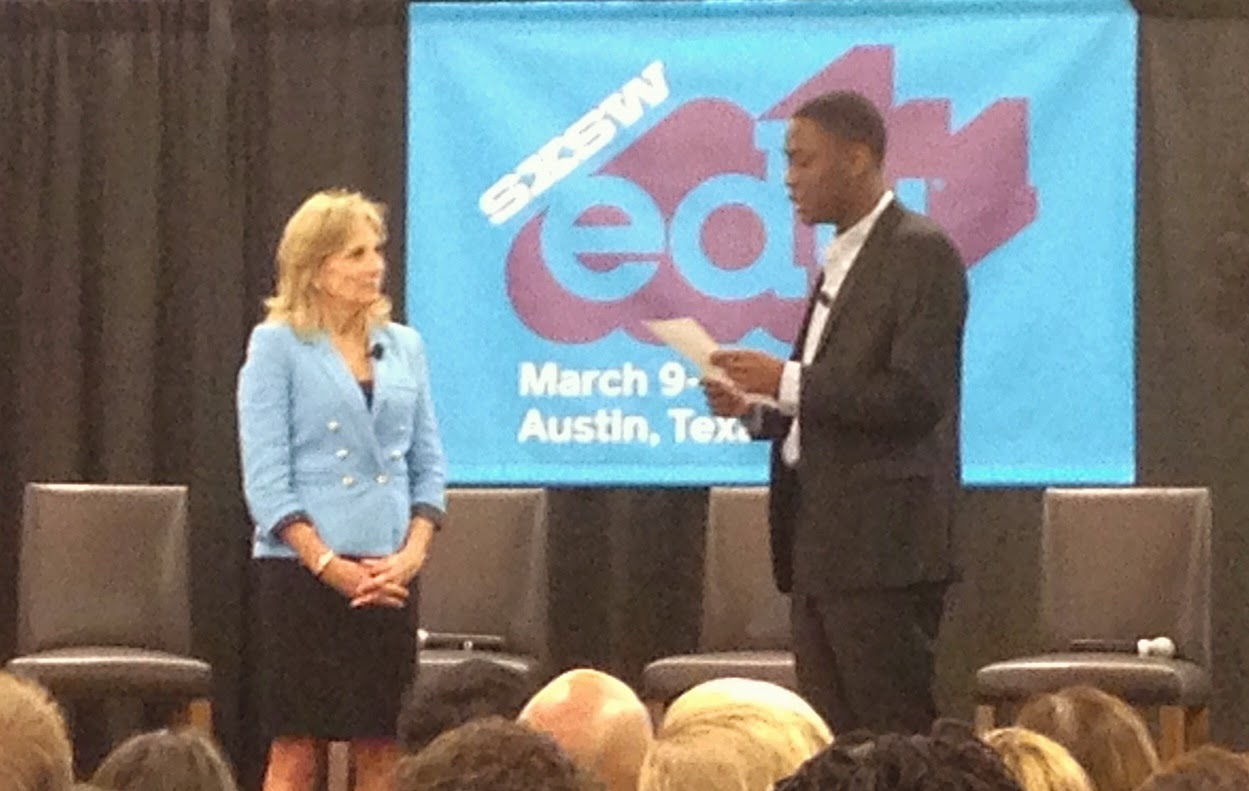
This morning, Second Lady Of The United States Dr. Jill Biden kept this dialogue moving forward in leading a summit by the Bill & Melinda Gates Foundation about redesigning higher education to fuel student success. Dr. Biden noted that education is the great equalizer, the basis for a better life. For this reason, she stressed, "Teaching is not what I do. It's who I am."
A panel discussion later with Jamie Casap, Timothy Jones, and Isis Stephanie Cerda focused more intently on the need for diversity within educational technology. Similar messages emerged in workshops on "Equal Opportunity For Deeper Learning," "My Brother's Keeper: One Year Later," and "Teaching A New Narrative For Black Male Achievement."
Source: ASIDE 2015
An equally critical thread appeared in the number of talks about empowering girls and women in technology and entrepreneurship. For example, EdTechWomen was named this year's official SXSWEdu Change Maker. Other titles included: "Women Disruptors 2.0," "Paying It Forward: Leveraging Today's Female Voice," "Empowering Girls And Women To Lead," "Digital Diversity: Minority Women In EdTech," and "EdTech For Educational Inclusion."
Another highlight of the day was Kristin Ziemke’s and Cheryl Boes’ presentation of innovative project examples to engage young learners with voice, choice, and audience. Their use of easy apps and elementary blogging revealed the many avenues that let children demonstrate understanding in exciting, authentic ways.
A later workshop featured a panel of thought leaders who promoted creativity in schools. They championed "less talking and more doing." The speakers paraded both theoretical and tangible ways to inspire kids as imaginative thinkers. As Jonathan Plucker, Professor at the University Of Connecticut, noted, “creativity is about constraints.” A teacher’s task, therefore, is to help students identify constraints and then decide which ones to get rid of, which ones to ignore, and which ones to live with.
Ultimately, after a day of education and introspection, of creativity and contemplation, we recalled John Ashbery's lines from Three Poems, which speak to the impossibility of certainty and the elusiveness of knowing:
"The term ignorant is indeed perhaps an overstatement, implying as it does that something is known somewhere, whereas in reality we are not even sure of this: we in fact cannot aver with any degree of certainty that we are ignorant. Yet this is not so bad; we have at any rate kept our open-mindedness -- that, at least, we may be sure that we have -- and are not in any danger, or so it seems, of freezing into the pious attitudes of those true spiritual bigots whose faces are turned toward eternity and who therefore can see nothing.”
Now in its fifth year, the 2015 SXSWEdu rally in the Texas midland is more inclusive than ever. The panelpicker judges eschewed trendy topics like flipped learning and Big Data in favor of deeper discussions about Social Emotional Learning and Gamification. Major themes that ran through the first day included programming in schools, authentic PBL, and contemporary professional development.
A major highlight of the day was hearing about the impressive Coded Curriculum implemented by Beaver Country Day School in Chestnut Hill, Massachusetts. The school has embraced a "launch / test / refine" approach to incorporate coding into every academic discipline. The faculty actively seeks to "make excellent mistakes" as they teach children the "New Basics" of open-ended problem solving, non-linear thinking, and collaboration.
Another centerpiece of the sessions was Sunni Brown's mesmerizing workshop about "how to stay curious." A guru of visual thinking and a doctor of doodling, Brown reminded the crowd that visual language is a river native to cultures across the world that instills a powerful cognitive awareness.
The spirit of sharing was genuine today at SXSWEdu. Every attendee was universally open and eager to connect. Yet a question kept trickling through the meandering hallways like the incessant drip of Austin’s rain: How many actual classroom teachers were present at the conference? When Brown asked how many classroom educators were in the room, fewer than ten percent among the hundreds raised their hands.
Source: ASIDE 2015
Throughout the day, we met: an online charter school principal, a start-up edupreneur, an NAACP coordinator, a not-for-profit founder, an NEA staffer, a Museum and Library Services researcher, a corporate communications director, a Learning Sciences professor, a former math instructor in Ethiopia, and a doctoral candidate who moonlights at Khan Academy. We met other interesting people, too, but we did not meet one classroom teacher.
We know they were there. But they seemed few and far between. Maybe this is a good thing. Maybe it signals that SXSWEdu is not for everyday teachers. Maybe the passionate attendees perceive a sea change in education that is more galvanizing than "regular" teachers can see. Or maybe not.
Either way, it speaks to a road diverging in a not-yet-understood wood. If start-ups and online outlets are careening onto their own edtech on-ramp, what happens to the students and teachers driving in the HOV lane?
For example, after participating in one session about a full-scale coding curriculum pushed across all disciplines, we attended a completely different panel about whether edtech really offers any solution at all. It feels strange that this question is still being asked: Is edtech a panacea or a distraction?
The nuanced nature of this tacit tech tug-of-war reminded us of a General Electric ad from September 2014 called "The Boy Who Beeps." The touching ad follows the birth of a baby who can speak the language of technology. The commercial intends to tout GE's omnipresence in electronics, but to us it highlighted the children today who are always plugged in, always wired.
Kids are born who can seemingly speak to machines, communicate with the digital world, control their own access to e-learning. What happens, though, when their days become disconnected? Can they muster the skills to navigate a tangible, interpersonal world? Or better yet, can they make things, create their own machines? Are they controlled by the very machines they rely on? And what about children who don’t have machines?
In the edtech learning space, are there start-ups who talk only to machines – and not to educators? And what about the teachers who cannot (or will not) talk to machines, who can’t negotiate the apps and iPads filling their classes?
By the end of today, we were encouraged. We decided that educators are indeed emerging as a potent force in the digital economy. American Federation Of Teachers President Randi Weingarten noted a change since last year's SXSWEdu. She now hears tech companies asking, “How can we get teachers involved in the process?” She emphasized that with the onslaught of shiny edtech tools, the best advice is to know how to teach first, and to learn to use technology second. Brown echoed the same, saying that digital tools are great, but they're not worth much if we can't use them. The learning is the key.
With the increasing questions we received from our sixth graders about the abhorrent news this past week, we realized they needed to do something to make them feel they were sending a positive message to help the world be a more peaceful place. Eleven- and twelve-year-olds hear the news, and most have far more access to content than their parents realize. Their questions abound and need an outlet. As middle school educators, we know this.
Source: ASIDE 2015
So with our friend and colleague, Francine Wisnewski (@fwisnewski), we decided to bring hearts and minds together to let the kids create a message to share on social media and with the school community. We asked them that each finished design somehow include a heart, map, and peace sign. That’s it. How they incorporated the criteria and with whom they worked, or not, was up to them.
We cherish the flexibility in our curricula that allows us to stop everything to promote mindfulness with our learners. It does not matter that the schedule listed math and history; we pulled the kids together to address their concerns about world conflict and violence.
Source: ASIDE 2015
We continually try to build the hearts and minds of our young learners to be peace builders, peacemakers, and peacekeepers. As adults, we understand the turmoil in the world, and sometimes we just have to stop to help them cope. It’s worth every minute. If we don’t, we lose the power of positive thinking that the world so much needs.









)