The end of another year gives us pause for reflection. The top search reported by Google Trends for 2021 was "how do we heal." We did not think much about it until we watched it and remembered just how difficult this year has been. Clearly, we have all been through so much. Our students were quiet, and our colleagues cried. Nothing else to add; it just helped us put things in perspective.

Saturday, December 18, 2021


Saturday, December 4, 2021
I Con, I Saw, I Conquered - Digital Fluency
 |
| Source: ASIDE 2021 |
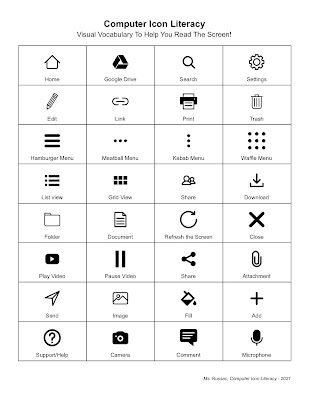
One thing we quickly learned during remote and hybrid learning involved the lack of understanding of screen iconology. We realized that our students needed to navigate the changing landscape of communication, not only for this unusual situation in pandemic learning, but also to understand the language of symbols on any digital device. It was one of those moments when adjustments to our instruction required a closer look at ensuring digital literacy to read and process crucial technology skills.
 |
| Source: ASIDE 2021 |
The adjustments we made in the curriculum to build in skills for students to develop a range of pictorial proficiencies for decoding icons and their functionality paid off, particularly with our remote learners.
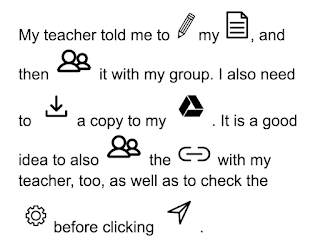
Visual fluency requires training and practice much the same as it does for reading; visual comprehension does as well. Today, students need to master multiple fluencies just as they do multiple literacies. Both require nurture and development to acquire these skills. We turned the learning process into a spy game for students to decipher the coded message using the icons. We provided a mentor text for them to grasp the idea and a one-page list of 32 icons to create their messages. Click here for a PDF version.
 |
| Source: Student Work |
To save time, we set up a folder with small icons that we downloaded from the Noun Project in Google Drive that we shared with the students so that they could write their own coded messages. Click here for access to our icon folder. The students loved it.
This not only reinforced their learning of the icons, but it also allowed us to build in a variety of technology skills for retrieving the resources they needed from a shared folder, importing images into a Google Doc, and adjusting image size and text for readability. The students had a ball sharing their coded messages with each other, and we had the results we were looking for in developing the their digital device iconology.
Monday, November 29, 2021
Student Infographics Come A Long Way!
 |
| Source: 6th Grade Students |
It's been over ten years since we first started using infographics with our students to make learning visible. They have certainly come a long way! Not only is this due to our ability to redesign aspects of our lessons to promote visual thinking and design, but also because the design tools are so much better. Our go-to creative tool now is Canva. It allows for so many options and templates. This flexibility enables students to make selections and modify their designs to look professional.
Since we use Canva it at multiple grade levels, they continue to perfect their visual literacy skills. The early "linear to visual" infographics using iPads and PicCollage seem so primitive now compared to the variety of selections in Canva. We do still use PicCollage for our Kindergarten through second grade students; it's a perfect tool for introducing our younger students to the art of learning and designing infographics.
 |
| Source: 6th Grade Students |
Tuesday, December 29, 2020
Ubiquitous Google, The Blob Opera, And Student Creativity
 |
| Source: Google Arts & Culture |
Our students fell in love with our refrain that "Google is ubiquitous; it's everywhere" when they realized that whatever they typed in their Google Docs showed up on any device. Now with Google Classroom, they especially see the connection that everything they need is synced in one place by multiple teachers. For educators, it makes hybrid learning streamlined for both remote learners as well as for those in the classroom, particularly when this situation remains fluid. Many know that the students are always checking their emails and Classroom with little to do because of the current situation.
 |
| Source: ASIDE Google Blob Opera |
So when we recently sent out Google's new project called the "Blob Opera" to Classroom over the winter break, the students happily started making their own four-person, musical creations. Blob participation depends on the producer. It's simple and easy to launch. Compose an opera with blob vocals ranging from bass to soprano in just minutes. It's also easy to share via Google Classroom as a teacher, and students can send their creations in the same way as an announcement to their peers.
For more information, check out Fast Company's article on how to manipulate the blobs to create a symphony of your own chamber music. Google did not use any recordings of actual singers. Instead, it built the system by recording "hours of classic opera singers, and used that data to train an AI model to know and mimic what an opera singer should sound like."
It's a nice way to end a crazy year by bringing in a new one with a little joy and creativity. If you're not actively checking Google's Art and Culture resources, start today.
Here's an opera from a very proud student: Irene's Blob Opera
Monday, December 7, 2020
'Tis The Season And Joy Was On The Menu - Student Designs To Promote Well-Being
 |
| Source: 6th Grade Students |
It's December, and it's been a long, long year for us as well as our learners. We're teaching hybrid, and our students go in and out depending on concern and fear of the virus. They definitely needed a pick me up by week 13, and that's when we read Dr. Dolly Chugh's recent post on Dear Good People entitled, "No Justice, No Joy."
 | |||
| Source: Dear Good People |

We couldn't ask for a more perfect advisory activity to promote joy as well as student agency and creativity. The students received a quick overview of the seven tips for a "Quick Joy Sandwich," with instructions for designing their own "Joy Menu" using a Canva template.
 |
| Source: 6th Grader |
Their charge was to think about the heading from the article that read "Joy is as essential as food" to create a menu complete with appetizer, main course, and dessert. They loved it. Each student brought his or her own take to the three course meal, and each handled the descriptions differently. They took the opportunity to create catchy headings of their own with descriptions for their plates that were anything but food.
 |
| Source: 6th Grader |
We wish we could share all of them, but the sampling is indicative of what can happen when kids have free range to express their joy, especially in the world they live in right now. For a full size look at these joyous delights, click here. No matter the season, joy is as essential to learning as it is to the social and emotional well-being of our learners.
What would your joy menu look like? As Dolly Chugh recommends, take a look at the tips she provides and make your own "Quick Joy Sandwich."
 |
| Source: 6th Graders |
Tuesday, June 23, 2020
Commitment To Design, Visual Thinking, And Now The Virtual Classroom
 |
| Source: ASIDE 2020 |
The reminder popped up today for our ninth anniversary since starting this blog. We had good intentions of entering the fall of last year, ready to contribute more to our passion and commit to haring our ideas, but life changes. We've had changes in job responsibilities, personal additions and losses to family, and of course, COVID19.
So today, on our anniversary, we begin anew. We never wavered from our initial mission; instead, we pivoted toward a range of other opportunities. While a good portion of what our students did was in the brick and mortar phase, it was the virtual classroom that advanced the realm of possibilities for learning. The last three months reminded us more of the 18th century nursery rhyme, "Jack be nimble / Jack be quick," with students jumping over "lickety split" to synchronous online sessions of remote learning. Metaphorically, it was a stressful breeze.
 |
| Source: Imagine Museum |
We were fortunate. Our students, already provided with devices and trained in using them, made the transition far easier than in many other cases. They worked on a number of different projects this year that pushed the boundaries of their design skills, their creative thinking, and their independence. As learners, they developed a knack for tackling new applications across a range of platforms to bring the world of transliteracy front and center, especially as it applies to digital humanities.
In the coming posts, we hope to share the latest work by our learners.
Thursday, August 1, 2019
Hate At Schools - An Infographic
 |
| Source: ASIDE 2019 Larger PDF Image |
Our students often ask us, "Why we can't end hate?" We only wish we had a definitive answer. It's not hard to discuss what we can do to help, but it's not easy when the adults constantly demonstrate the opposite. Instead of adults doing everything they can to diffuse the spread of hate through the media, they fuel the fire of hate that often leads to appalling violence. It is no wonder that since the presidential election of 2016, the rise of hate and bias in schools has increased.
A special report called "Hate At School 2018" from Tolerance.org shows that schools are faced with challenges now more than ever. The study tracked hate and bias incidents for over a year; the data is a grim reminder of their pervasive rise in our schools. The incidents reported range from elementary to secondary school, both on and off campuses, and in all 50 states. Unfortunately, the news reports of these incidents is "only the tip of the iceberg."
 |
| Source: ASIDE 2019 Larger PDF Image |
Education and schools need to be vigilant about matters of inclusion. We need learners who aspire to be empathic, who understand that diversity is fundamental, and who accept that being different is a choice.
Our hope as we start the new school year is to keep these aspects in mind as we go about our routines, rituals, and traditions.
For more information, please see:
Subscribe to:
Posts (Atom)

)